As a player who has journeyed from the turbulent launch of Cyberpunk 2077 to the triumphant redemption brought by Update 2.0 and the Phantom Liberty expansion, my excitement for the sequel, Project Orion, is palpable. This anticipation feels like a genuine revival, a sentiment that would have seemed unthinkable in the game's earlier days. While the core game's transformation was monumental, a significant part of that renewed passion for Night City's lore and mechanics was undeniably ignited by the Cyberpunk: Edgerunners anime. The show didn't just tell a compelling story; it showcased a version of Cyberpunk's technology—especially the Sandevistan Operating System—with a visceral intensity that the game, even at its best, only partially captured. For Project Orion to fully realize its potential, it must integrate the essence of Edgerunners from the ground up, and no element deserves this treatment more than the Sandevistan.
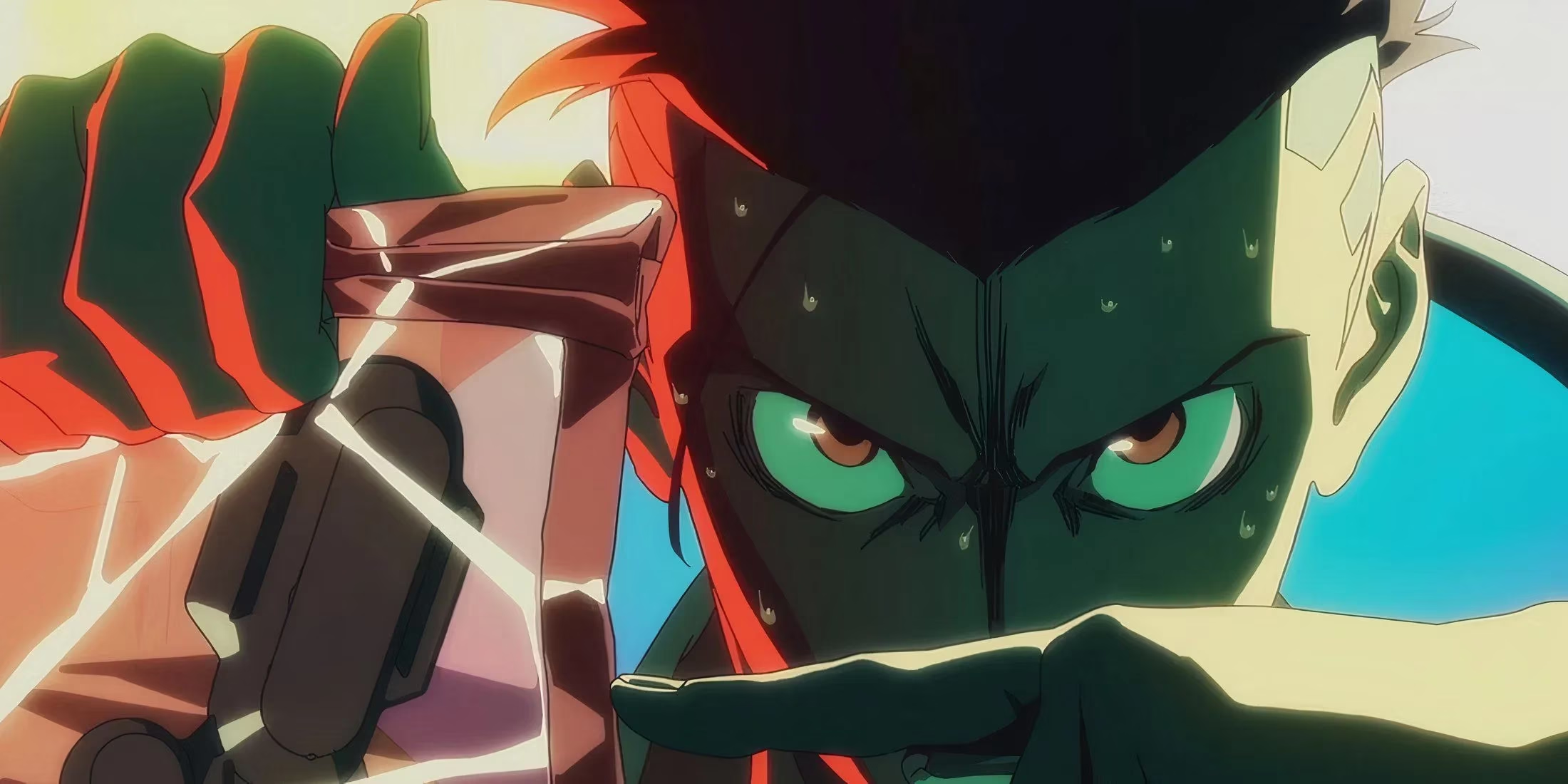
The Sandevistan, as depicted in Edgerunners, is not just a tool; it's a narrative device and a Faustian bargain. Witnessing David Martinez implant that military-grade piece of cyberware was a defining moment. It granted him a god-like perspective, slowing time to a crawl and allowing him to outmaneuver foes with impossible grace. However, the anime masterfully portrayed the devastating cost. Each activation wasn't a free power trip; it was a step closer to cyberpsychosis, a mental and physical erosion that threatened to consume him entirely. This created a perfect, thrilling tension: immense power inextricably linked to profound personal risk. In Cyberpunk 2077, while the Sandevistan became a fan-favorite build after the 2.0 overhaul, it often felt like a skill on a cooldown rather than a transformative, high-stakes ability. The short duration and lengthy recharge, implemented for game balance, unfortunately placed a barrier between the player and the raw, unadulterated power fantasy promised by the anime.
For Project Orion, the path forward is clear. The developers should dare to remove these artificial limitations. Imagine a Sandevistan without a strict timer, where the only limit is your character's own resilience. The perfect balancing mechanism already exists within the established lore: a deepened and more consequential cyberpsychosis system. Instead of a simple cooldown or a debuff for exceeding a cyberware limit, the game could introduce progressive, tangible consequences for overuse:
-
Initial Stages: Visual distortions, audio hallucinations, and minor physical penalties like occasional tremors or nosebleeds (as hinted at in the show).
-
Advanced Stages: More severe combat debuffs, hostile faction reputation changes as you become unstable, and narrative choices being influenced by your character's deteriorating mental state.
-
Critical Stage: Risking a complete, potentially game-altering psychotic break if pushed too far, forcing players to seek costly in-world remedies or face permanent consequences.
This system would transform the Sandevistan from a powerful skill into a core pillar of role-playing, where the player must constantly weigh immediate, overwhelming power against long-term sanity. It would finally deliver the true "David Martinez experience."
Furthermore, Project Orion has a golden opportunity to expand the Sandevistan's role through meaningful variants and specializations. Edgerunners showed us at least two distinct versions: David's versatile model and Adam Smasher's monstrously powerful one. The sequel should build on this, moving beyond the incremental stat boosts offered in 2077. Imagine choosing from different corporate-manufactured Sandevistans, each with unique philosophies and gameplay impacts:
| Manufacturer / Model | Core Philosophy | Gameplay Effect & Specialization |
|---|---|---|
| Militech "Apogee" | Military-grade reliability and sustained combat efficiency. | Longer base duration, integrates seamlessly with smart weapon targeting systems. Favors a tactical, soldier-like approach. |
| Arasaka "Warp Dancer" | Precision and executive protection. | Creates a brief, impenetrable personal time-dilation bubble, perfect for evading attacks and setting up precise, single-target eliminations. |
| Kang Tao "Flow State" | Smuggler and infiltrator special. | Quieter activation, reduces enemy detection range during use, and allows for faster interaction with objects and hacking points while time is slowed. |
| Biotechnica "Synaptic Boost" | Pushing human limits, regardless of cost. | Most potent raw time-slowing effect, but has the highest and fastest-accumulating cyberpsychosis risk. For those who live on the absolute edge. |
These variants would not only cater to different playstyles—be it a silent infiltrator, a frontline berserker, or a precise duelist—but also deepen the world-building. The choice of your Sandevistan could affect how certain corporations or fixers perceive you, opening up unique narrative branches and quests. It would make each playthrough feel distinct, especially for the legion of players who adore the Sandevistan-centric combat style.
In essence, by learning from Edgerunners, Project Orion can elevate its cyberware from being mere stat-sticks to being the heart of both gameplay and narrative. The Sandevistan, reimagined with true risk, meaningful progression, and diverse corporate flavors, could become the definitive feature of the sequel. It would fulfill the ultimate promise of the cyberpunk genre: offering god-like power, but always reminding you that in Night City, everything comes with a price—and that price is often your own humanity. As a fan, that's the deeper, more dangerous, and infinitely more compelling Night City I want to revisit in 2026 and beyond.