As the gaming world continues to evolve, the enduring legacy of CD Projekt Red's flagship titles, Cyberpunk 2077 and The Witcher 3: Wild Hunt, remains a topic of fascination. In 2026, years after their initial releases, a compelling narrative persists that these expansive worlds still hold undiscovered mysteries. Pawel Sasko, a veteran developer whose fingerprints are all over both masterpieces, stands at the heart of this intrigue. Having served as lead quest designer for The Witcher 3 and quest director for Cyberpunk 2077 and its Phantom Liberty expansion, Sasko maintains a firm conviction: secrets lie dormant within Night City and the Continent, waiting for the keen-eyed player to unearth them.
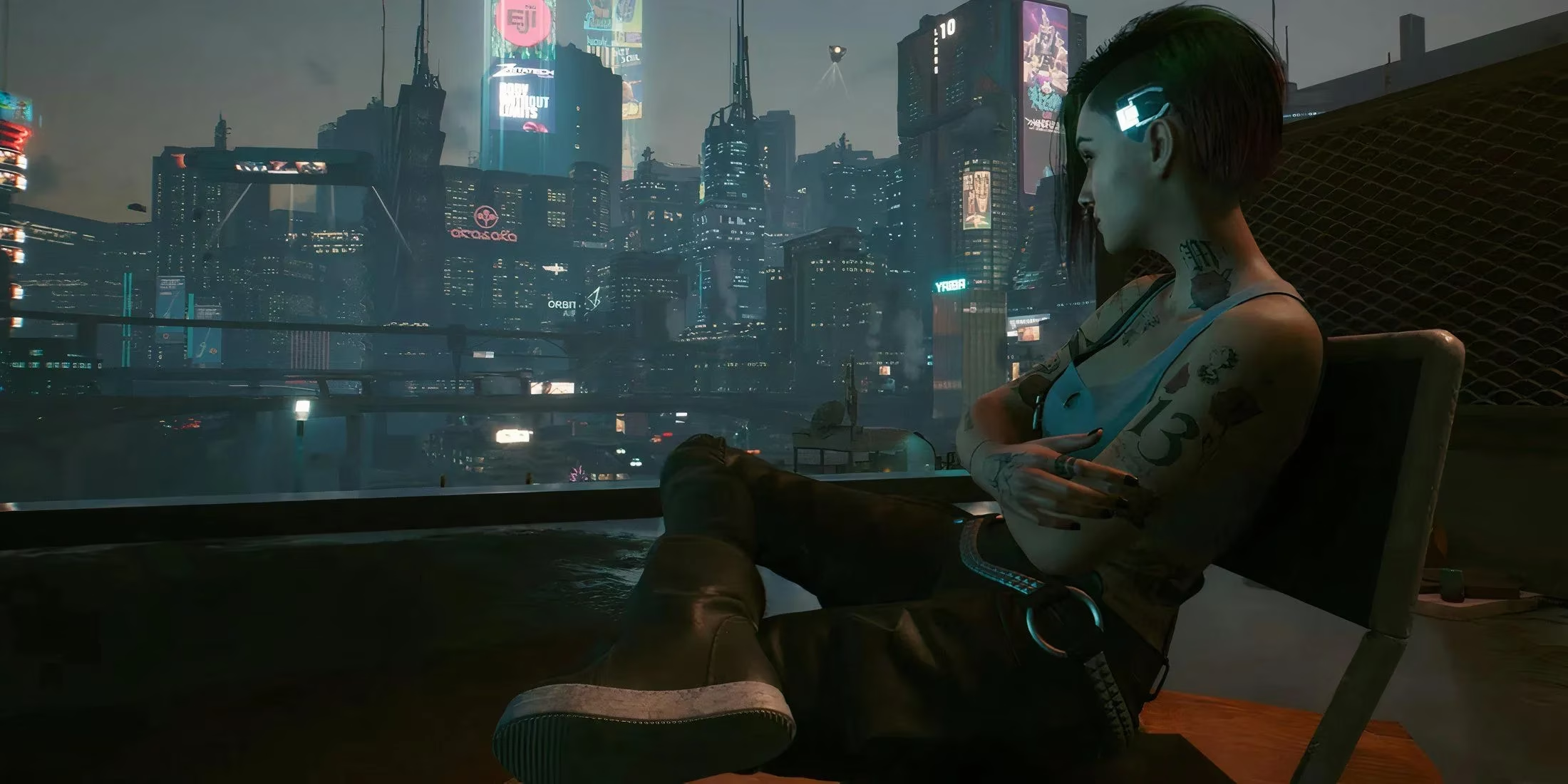
The art of embedding these hidden layers is a core tenet of CD Projekt Red's design philosophy, particularly in quest creation. Sasko has often highlighted empathy as the foundational element, allowing developers to craft narratives that resonate deeply with players. However, woven into this empathetic framework is a secondary, playful objective: seeding the game worlds with 'Easter eggs' and cryptic puzzles designed for long-term community engagement. This approach transforms a single-player experience into a collaborative, years-long treasure hunt. Sasko's delight is palpable when he discusses watching players, sometimes nearly a decade after a game's launch, stumble upon references and secrets for the very first time, proving the longevity of this design choice.
One need only look at the community's track record to see this philosophy in action. Sasko points to a recent example from the Phantom Liberty expansion that brought him joy. For years, a seemingly innocuous scene in the Black Market—two men sitting on a metal beam—went unnoticed or uninterpreted. It was only in recent years that astute players on forums finally connected the dots, identifying it as a loving homage to the famous Lunch atop a Skyscraper photograph of construction workers on the Chrysler Building. This delayed discovery exemplifies the kind of layered, cultural reference the team loves to hide. 🕵️♂️
Of course, not all secrets are simple visual nods. Some evolve into legendary community-wide puzzles. The developer explicitly mentioned the infamous FF:06:B5 mystery from Cyberpunk 2077. This enigma, which incorporates hexadecimal codes, QR codes, and cryptic imagery related to The Witcher series, blossomed into one of the most complex and debated secrets in modern gaming. What fascinates Sasko is not just the puzzle's complexity—which he believes is insurmountable for a solo player—but the rich tapestry of fan theories it has spawned. He openly admits that while the community's interpretations "make sense," they often diverge completely from the developers' original intent. This divergence, however, is seen not as a failure but as a success; the secret became a living narrative shaped by its players.
| Game | Notable Undiscovered/Evolved Secret | Community Impact |
|---|---|---|
| The Witcher 3: Wild Hunt | Ongoing discoveries of environmental 'Easter eggs' | Sustained forum activity and theory-crafting years post-launch |
| Cyberpunk 2077 | The FF:06:B5 ARG (Alternate Reality Game) | Collaborative, cross-platform puzzle-solving efforts |
| Phantom Liberty | Hidden cultural references (e.g., Chrysler Building photo) | Moments of shared discovery and appreciation for detail |
The process of creating these enduring mysteries is deeply informed by developer engagement with the player base. Sasko instructs his team to watch streamers and engage with community discussions actively. This practice serves a dual purpose:
-
It provides direct insight into the player's mindset, revealing how they navigate dilemmas and explore the world.
-
It helps developers understand the collective problem-solving approach of a community, which is crucial for designing secrets meant to be solved collaboratively over years.
He cites moments in Phantom Liberty where streamers would agonize for extended periods over morally complex choices as a benchmark for successful dilemma design. This understanding allows the team to craft hidden elements that are challenging yet fair, knowing the combined intellect and perseverance of the global player community will eventually piece them together.
Looking to the future, the implication is clear. The culture of embedding deep, well-hidden secrets is likely a permanent fixture in CD Projekt Red's development cycle. As new titles are developed, players can likely expect the same careful planting of mysteries meant to unfold not in hours, but in years. The worlds are built not just to be completed, but to be lived in and scrutinized. For developers like Pawel Sasko, the greatest reward is the enduring conversation between the game and its players, a dialogue that continues to find new voices and uncover new layers long after the credits first roll. The hunt, it seems, is never truly over. 🔍