Let me tell you, you haven't truly lived until you've seen a video game company pull off a comeback so spectacular, it makes Lazarus look lazy. I'm talking about the saga of CD Projekt Red, a story of hubris, catastrophe, and a redemption arc so ambitious it could fuel a dozen sci-fi epics. As a player who was there in the trenches during that launch, I can still feel the phantom pain of the bugs. But fast forward to 2026, and witnessing their climb from the ashes? It’s been nothing short of cinematic.
Paweł Sasko, the associate game director steering the ship for the next Cyberpunk, once told me a hard truth over a digital interview. He admitted that for some players, the trust was broken beyond repair. "It might be a situation that never happens for some of them," he said, his voice carrying the weight of 2020's ghost. "But that's unfortunately the price we had to pay." His words struck me. Here was a leader not making empty promises, but declaring a simple, brutal philosophy: We will prove it with what we build. No more words. Just work.
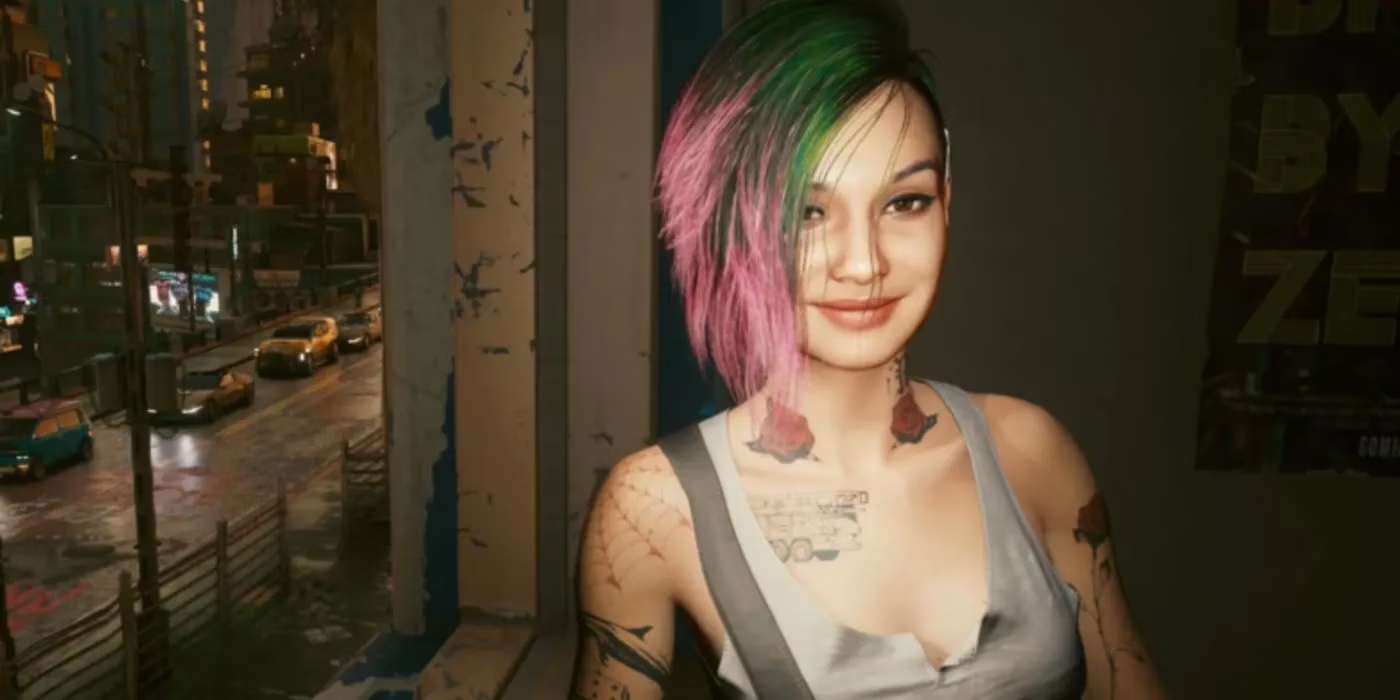
And oh, how the work began! The co-CEO, Michał Nowakowski, called the launch "one of the worst moments of [his] life." The damage to the studio's reputation was a deep, festering wound. The share price tanked, memes were born in fire, and Night City felt less like a promise and more like a prank. But from that nadir, something shifted. A grim, determined silence fell over the studio, followed not by excuses, but by an avalanche of patches, updates, and a commitment so fierce it melted my cynical heart.
The transformation wasn't overnight. It was two years of relentless, thankless labor. Then came Phantom Liberty. It wasn't just an expansion; it was a statement. A declaration of war on their own past failures. Launching to acclaim that felt like a collective sigh of relief from the gaming world, it was the turning point. Critics who once sharpened their knives were now handing out laurels. The public perception, once a toxic cloud over Warsaw, began to clear. It was the first, glorious proof that the studio had learned, had grown, had listened.
Here’s what changed the game for me and millions of others:
🎯 Relentless Polish (Literally and Figuratively): The bugs were hunted to near extinction. Stability became the new mantra.
🚀 Feature Revolution: The 2.0 overhaul didn't just fix; it reimagined. Police systems, skill trees, vehicular combat—everything got a next-gen heart transplant.
❤️ Narrative Mastery: Phantom Liberty delivered a spy-thriller story with emotional depth that rivaled the best of The Witcher. It showed they never lost their soul, just their way.
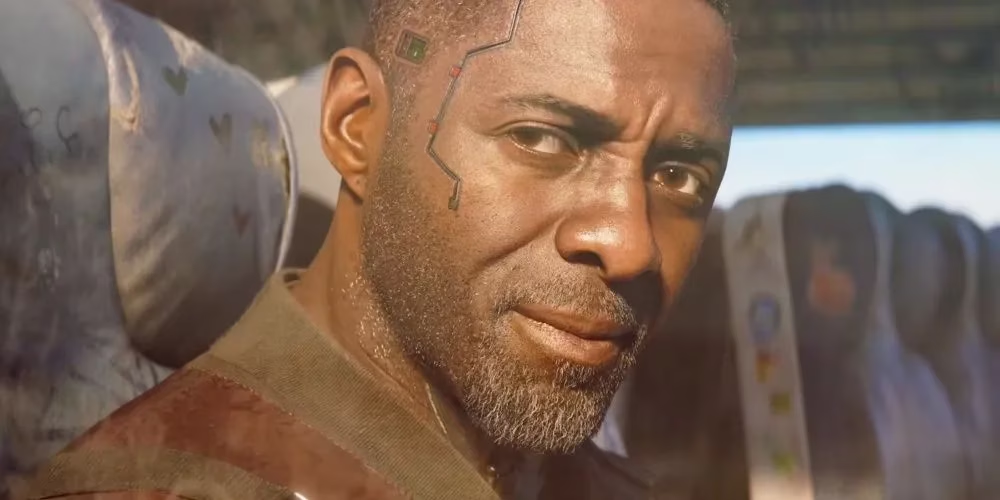
The energy today, in 2026, is electric. The conversation has completely shifted. We're no longer asking "Can they be trusted?" We're buzzing about Project Orion (the Cyberpunk sequel), the next Witcher saga, and the mysterious new IP, Hadar. The studio's roadmap isn't a list of promises; it's a portfolio of earned anticipation. Sasko's hope is becoming reality—players are reaching out, playing, and genuinely enjoying. The value is now undeniable, baked into every line of code and narrative beat.
| The Era of Mistrust (2020-2022) | The Era of Redemption (2023-2026) |
|---|---|
| Broken promises on last-gen consoles | Rock-solid performance across all platforms |
| A narrative buried under bugs | Stories celebrated for their depth and choice |
| Studio reputation in tatters | Reputation rebuilt through demonstrable action |
| Player base fractured and angry | A renewed, passionate community driving engagement |
Looking back, the disaster of 2020 was a brutal, necessary teacher. It forged a new CD Projekt Red—one that is humbler, more transparent, and more fiercely dedicated to quality than I ever thought possible. They paid the price, and they are paying it forward with every project on the horizon. The comeback is complete. The phoenix has risen, its wings forged from patches, passion, and the phenomenal Phantom Liberty. The future isn't just bright; it's blinding. And I, for one, have never been more excited to play.