It was during a late-night session in 2026, chasing down another cyberpsycho report in the grimy underbelly of Night City, that I stumbled upon something that made my blood run cold. I had just put down Ellis Carter, a Maelstrom enforcer whose mind had been shattered until he was little more than a rabid animal. As his body slumped to the floor of the industrial yard, something felt off. The cyberware on his face, the iconic chrome visage of the Maelstrom gang, looked... wrong. Closer inspection revealed a grotesque secret—a gaping hole where his facial implant should have been anchored. And beneath it, peering out from the void, was not just exposed wiring or synth-flesh, but the unmistakable contours of a human face.
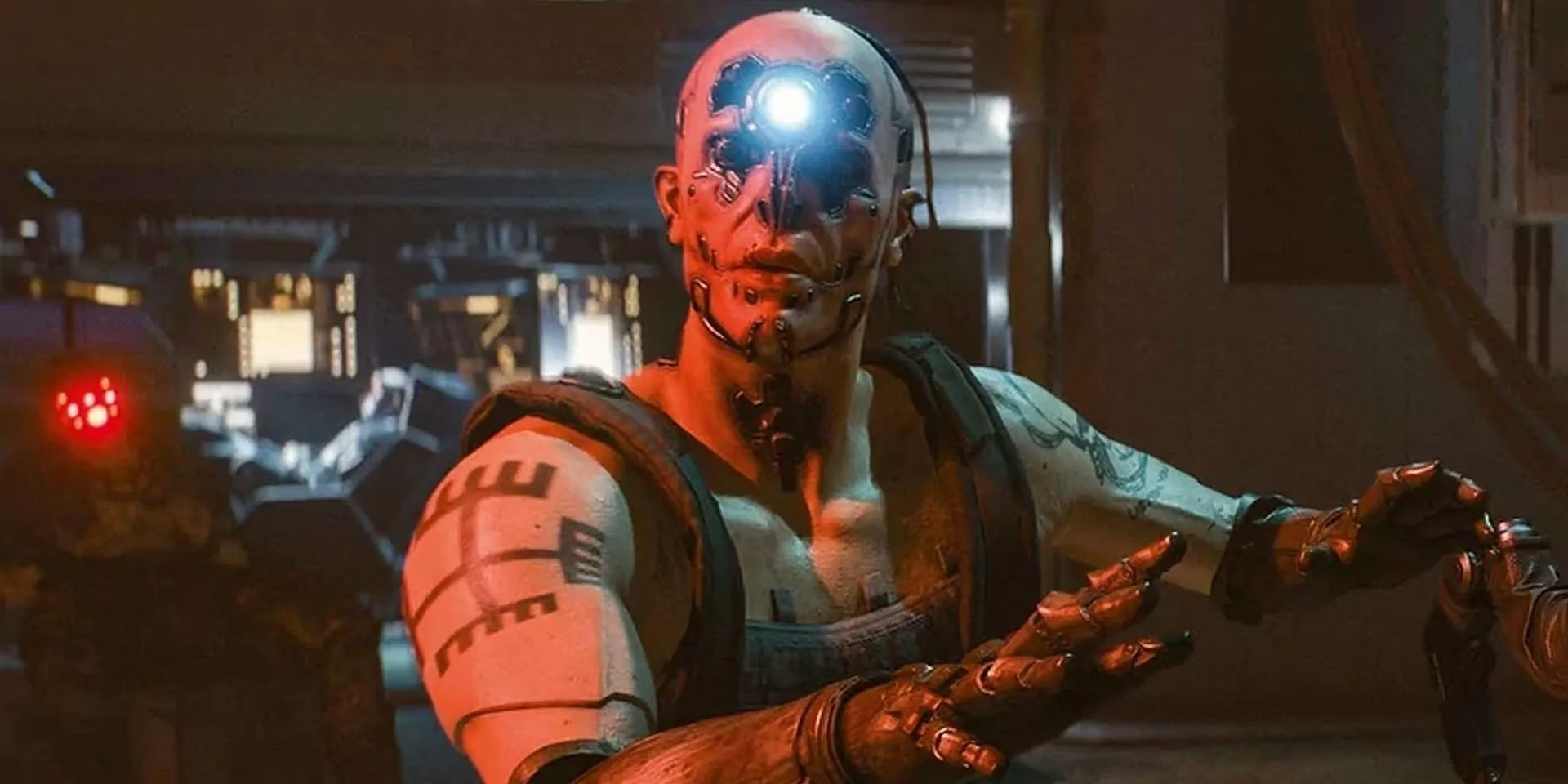
My hands froze on the controller. This wasn't a glitched texture or some unfinished asset. It was a face. Pale, with brows still intact, staring back from the hollow chassis of what was supposed to be a full-face cybernetic replacement. It was a sight straight out of a nightmare, a horrifying blend of man and machine that I wasn't supposed to see. In that moment, the Maelstrom didn't just seem like chrome-plated psychos; they became something far more unsettling. The lore says they fetishize cyberware, that they replace flesh with metal for the thrill. But what if the reality is even more disturbing? What if the chrome isn't a replacement, but a cage?
I wasn't the first to see it, of course. The discovery had originally been made years ago by a player named ScrapMetal4000 during the very same mission, 'Where the Bodies Hit the Floor.' But time, and countless patches and updates from CD Projekt Red, hadn't erased the image from my mind. ScrapMetal had posted his findings back then, sparking a firestorm of theories. Was it a design choice? A deliberate narrative hint that the chrome is bolted on, not grafted in? Or was it simply a texture bug, a digital skeleton key that wasn't meant to be found?
Let me tell you, the theories flew faster than MaxTac through a corpo plaza.
-
The Layered Theory: The most practical explanation came from fellow players. They argued it was simply how the game was built. CD Projekt Red likely used a standardized NPC model as a base and layered the Maelstrom cyberware on top of it for efficiency. The lore implications, however, were terrifying: this meant the Maelstrom's signature look—their chiseled, inhuman metal faces—wasn't achieved by replacing the face, but by screwing plates and optics directly through the existing skull and flesh.
-
The Texture Bug Theory: Others were convinced it was a graphical error, an unintended peeling back of the game's reality. They compared it to seeing a character model's healthy skin under burned textures—a digital secret revealing the man underneath the machine's costume. ScrapMetal4000 himself had eventually agreed with this camp.
-
My Theory: Staring at Ellis Carter's ruined face on my own screen in 2026, I don't think it's a bug anymore. I think it's a ghost in the machine. A remnant of the original artistic intention that survived all the updates. A chilling piece of environmental storytelling.
The revelation had sparked a range of discussions back then, and revisiting them now, with the game's world feeling more lived-in than ever, they hit different. One player had suggested it made the Maelstrom more horrific, and they were right. It wasn't the bug that was scary; it was the implication. Another had said they couldn't 'even describe how uncomfortable' it made them feel. I can. It's the uncanny valley of cyberware. It's the horror of realizing the chrome might not transform you into something new and alien, but simply lock the old, screaming you inside a new, silent shell.
Whatever the reason for those mysterious faces peeking through the chrome, Cyberpunk 2077 players didn't like it then, and frankly, we still don't. It's one of those secrets Night City isn't meant to give up. It shatters the fantasy. Before, you could dismiss a Maelstrom ganger as a chrome-plated psycho whose humanity had been erased by metal and wire. Now? You see the prison. You see the face in the chrome cage, and you wonder if they ever even wanted to get out.
This discovery changed how I saw every Maelstrom encounter. I'd be clearing out a scav haunt, and there they'd be, lurking in the shadows. The aggressive, twitchy movements, the vocal distortion from their voice modulators—it all took on a new layer. Were they truly reveling in their modifications, or was there a desperation to the fetishization? Were these surgeries of empowerment, or procedures of entrapment? The game never explicitly says, but the evidence is there, in the hollow spaces behind their eyes.
Later, I started looking closer. During other missions, in firefights where a Maelstrom's helmet would get blown clean off, I'd try to catch a glimpse. It's difficult, the action is fast, and the damage models are detailed but not that detailed. But sometimes, just sometimes, in a perfectly timed explosion or a well-placed sniper shot that shears off a jaw plate, the same hollow architecture is visible. A modular system built on a base.
I can't prove it's intentional. Maybe it was a shortcut, a development artifact. But the fact it persists years after launch, through graphical overhauls and engine tweaks? That feels less like a bug and more like a foundational truth.
The Maelstrom are not just scary because they are unpredictable psychos. They are terrifying because, in that moment of digital deconstruction, you are forced to confront the man who chose the cage. And you have to ask yourself, staring back at your own reflection in the screen of your television: in Night City, haven't we all screwed something straight through our own skulls, hoping no one would ever see the face we left behind?