The rain of Night City has a way of washing away blood, but not the stains on the soul. Every step I take as V feels like walking on glass, each decision a potential shard that will cut me later or pave a path forward. In this sprawling, neon-lit dystopia, the line between mercy and pragmatism is as thin as a monofilament wire, and nowhere does it hum with more tension than in the shadow of the Arasaka parade, facing a man named Sandayu Oda.
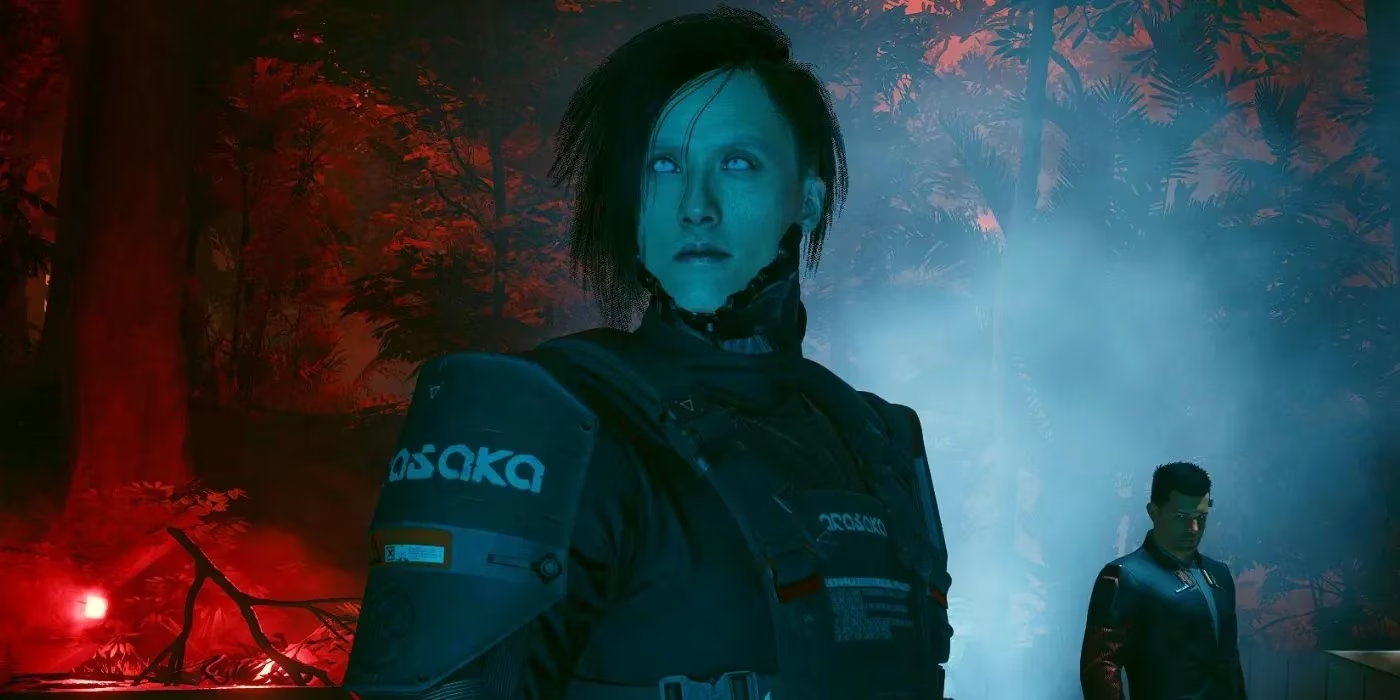
Who is this specter in chrome who blocks my path? He is more than Hanako Arasaka's silent guardian. He is a living testament to a bond forged in the fire of corporate loyalty, a bond with my own unlikely ally, Goro Takemura. Takemura, the man now guiding me through this viper's nest, was once the one who molded Oda, who taught him the sacred art of protection. Their shared history is not just a footnote; it's a silent plea that hangs in the air between bursts of gunfire and the screech of mantis blades. When Oda urges us to silence, to bury the truth of Saburo's demise, it is not mere obedience—it is the creed of a soldier protecting the family he serves from the vulgar gaze of the world. To face him is to clash with a perfect weapon, a whirlwind of lethal precision and deceptive technology that pushes my skills to their absolute limit.
And then, the moment arrives. The fight is over. Oda lies broken at my feet, a testament to my will to survive. The air is thick with static and the metallic scent of ozone and blood. Takemura's voice cuts through the haze, a desperate, human sound in this temple of machinery. "Spare him," he implores. In that instant, I am not just a mercenary chasing an eddy; I am the arbiter of a future yet unwritten. The choice is binary, stark, and heavy:
-
The Path of the Reaper: To end Oda is to claim his legacy, to pry the iconic Jinchu-Maru katana from his cooling grasp. This blade, a sleek obsidian shard bearing the Arasaka insignia, is more than a tool. It is a story—once Takemura's, then a gift to his pupil, now a trophy for his vanquisher. Its edge promises devastating power, especially against the titans and elites that stalk Night City. To take it is to embrace a ruthless efficiency, to sever a thread of the past cleanly.
-
The Path of the Ghost: To spare Oda is to heed a different call. It is to acknowledge the fragile web of loyalty and honor that even this cynical world cannot fully extinguish. It is to make a choice whose consequences are not material, but spectral, echoing into the darkest possible finale.
For if I show mercy, and if I also manage to pull Takemura from the jaws of death in the chaotic aftermath of the parade, a remarkable narrative symmetry unfolds. In the bleak, corporate purgatory of The Devil ending, where I side with Hanako Arasaka, I do not walk alone. Among the chilling, boardroom politics and the spectral unveiling of Saburo's engram, familiar faces stand with me. Takemura, alive and resolute, calls upon his old allies. And there, standing beside him, is Oda. His pride wounded but his duty unwavering, he becomes a silent, intimidating pillar of support for Hanako's coup. He fights alongside us, a whirlwind of vengeance and loyalty, clearing a path through Yorinobu's forces as we ascend the monolithic Arasaka Tower.
| Choice for Oda | Immediate Consequence | Potential Long-Term Payoff (The Devil Ending) |
|---|---|---|
| Execute | Acquire Iconic Jinchu-Maru Katana. Takemura expresses anger and disappointment. | Oda does not appear. The narrative thread is cut. |
| Spare | No material reward. Takemura's alliance is strengthened. Oda is taken for medical treatment. | If Takemura survives, Oda returns as a combat ally during the Arasaka Tower assault, adding narrative depth. |
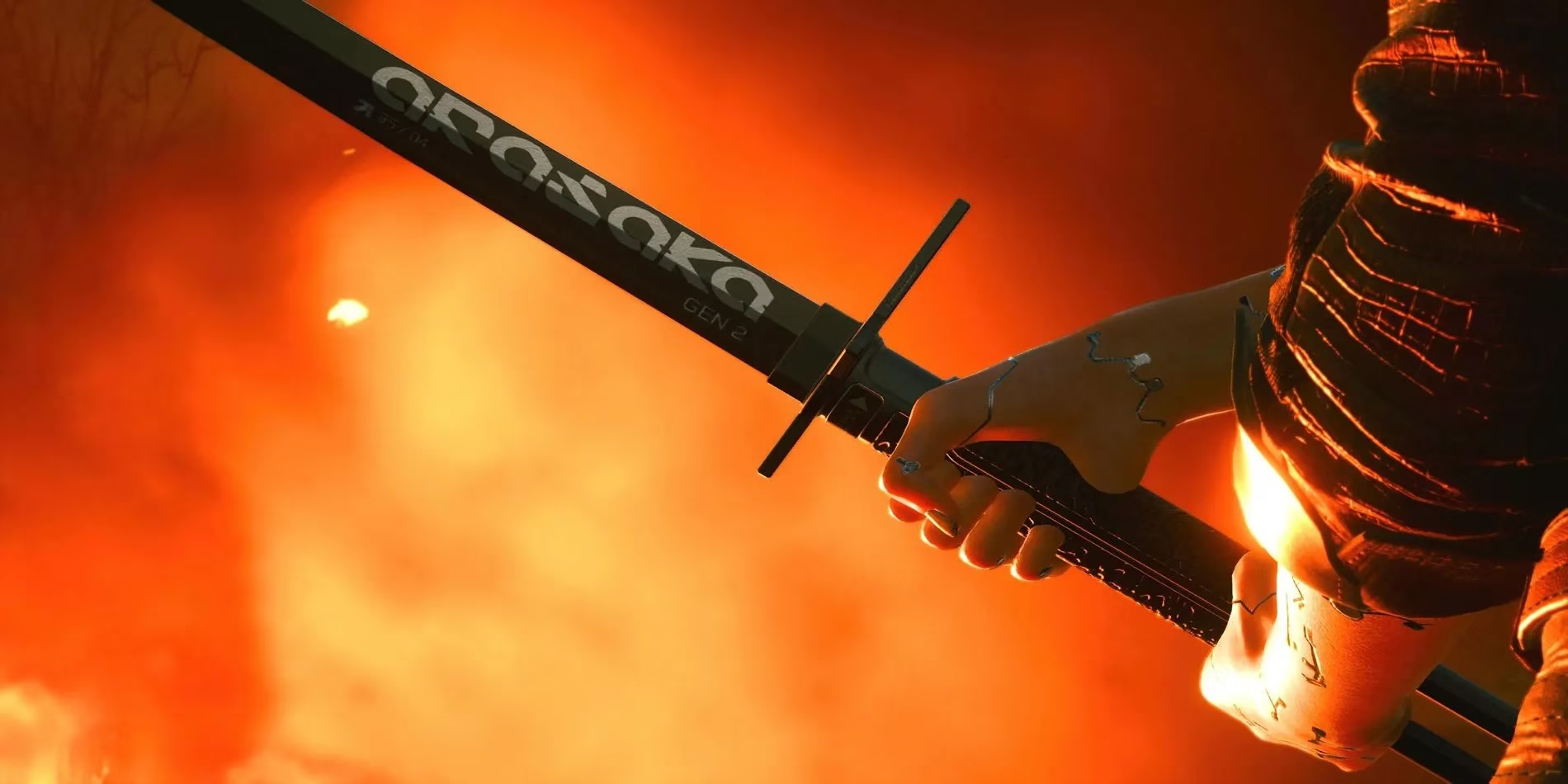
His role, while not altering the crushing, existential outcome of that ending, is a profound whisper in the silence. It is a reminder that in a world designed to strip away humanity, the echoes of our compassion—or lack thereof—can still find a way to resonate. He does not follow us to the very pinnacle, to face Yorinobu; his duty, reforged in defeat, binds him to Hanako's side. Yet, his presence transforms that grim march from a solitary betrayal into a fleeting, poignant fellowship.
This, then, is the essence of the choice: a weapon of legendary sharpness now, or the ghost of an ally in a possible tomorrow. As I stood over Oda in 2026, the weight of my origin story—be it the ruthless Street Kid, the principled Nomad, or the calculating Corpo—pulled at my conscience. Does my V see only another obstacle to be dismantled, another piece of loot to be claimed? Or do they see the reflection of Takemura's honor, the complex man beneath the cybernetic shell, and choose to leave a thread of humanity intact?
The beauty of Night City's labyrinth is that it offers no correct answers, only consequences that ripple through the narrative bloodstream. Sparing Oda grants no extra eddies, no superior cyberware. It offers something far more elusive: a fragment of narrative cohesion, a small victory for the heart in a war fought with chrome and cold logic. It makes the haunting, sterile conclusion of The Devil feel slightly less lonely, a subtle testament to the bonds that can survive even in the belly of the corporate beast. In the end, the choice is not about Oda's fate, but about defining the ghost I will become in the machine.