In the quiet halls of digital creation, where stories are spun from code and imagination, the soul of a great role-playing game often lies not in a single element, but in the harmonious, intricate dance between narrative and gameplay. The latter is not merely a vessel for the former; it is the very soil from which the story's unique flavor grows, the mechanism through which a player's identity within the world is forged. It is the alchemy that transforms a sequence of events into a personal legend. When developers weave gameplay so deeply into the fabric of their worldbuilding that the two become indistinguishable, they ascend from craft to artistry, birthing experiences where the journey itself—the how of progression—becomes as memorable as the destination. For those adventurers yearning to step beyond the well-trodden path of conventional arms and archetypes, these worlds offer a canvas for the wonderfully unconventional, inviting players to discover novel and fantastical builds that challenge the very definitions of combat, magic, and character.
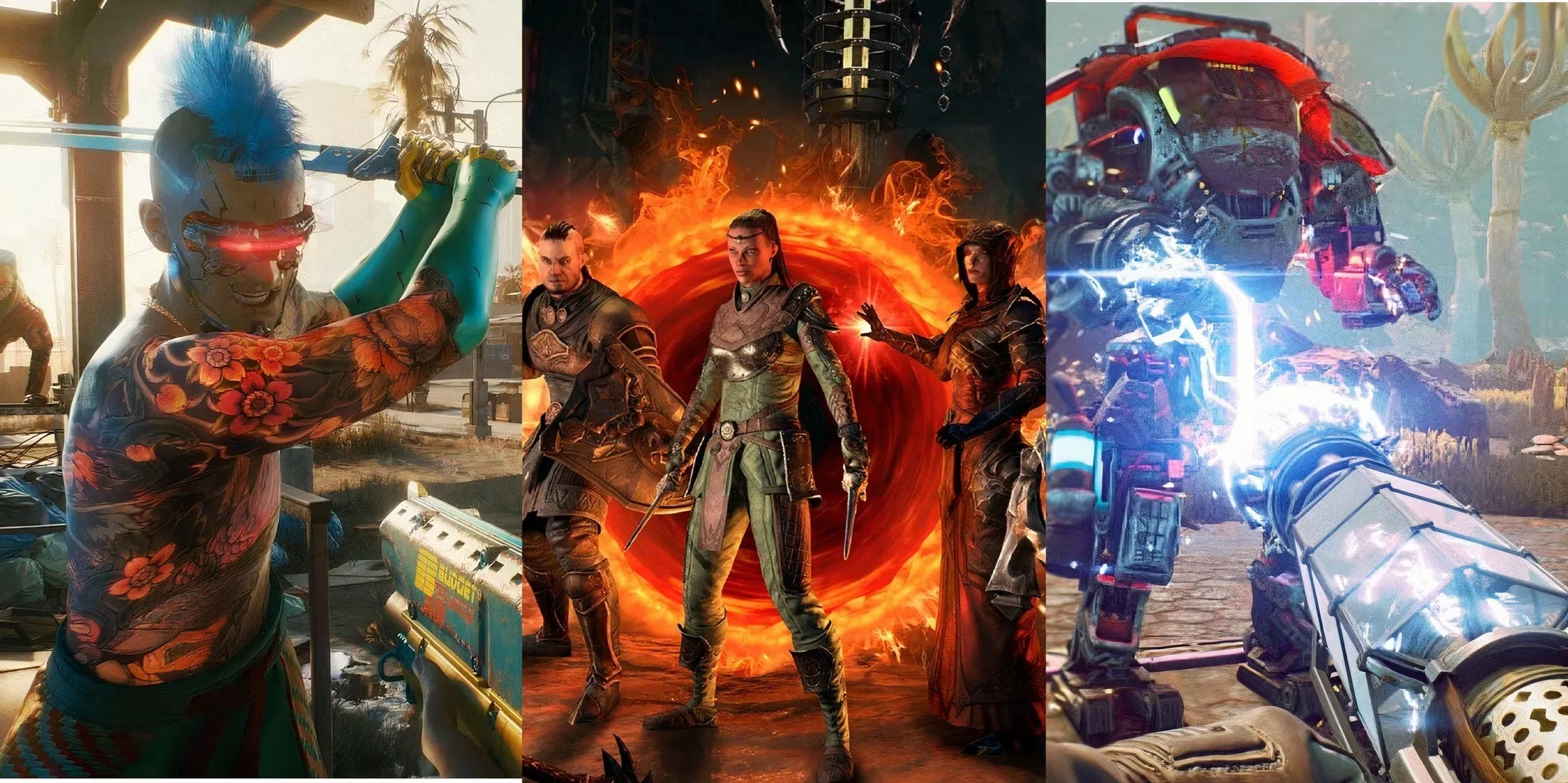
🏰 Morrowind: The Tapestry of Tamriel's Possibilities
Long before the streamlined paths of later journeys across Tamriel, the island of Vvardenfell stood as a testament to unbridled possibility. The Elder Scrolls III: Morrowind presented a world where character creation was not a prelude to a predetermined hero's journey, but the first stroke on a vast, blank canvas. Here, the archetypes bled and blended into something entirely personal. One could forsake weapons entirely, becoming an unarmed master whose fists carried the weight of spells or raw power. The spell-slinging monk, the smooth-talking illusionist who conquered with words and whispers—these were not mere concepts but viable, thrilling paths. The arsenal itself spoke of diversity: the long reach of spears, the crushing authority of hammers, the enchantable potential of the quarterstaff. The game's genius lay in its silent promise: built with care and understanding, almost any combination of skills could weave a path to victory, making each adventurer's tale uniquely their own.
🎲 Fallout: New Vegas & The Outer Worlds: The Symphony of Skills and Perks
In the sun-bleached, morally ambiguous wastes of the Mojave, Fallout: New Vegas elevated character building to a form of expressive, chaotic science. The game's sprawling perk system acted as a toolkit for personal ideology, allowing players to sculpt Vault Dwellers who interacted with the world in profoundly specific ways. Want to maximize damage through sheer, ruthless charm? The game provided avenues for that. The desire to clear a room not with stealth, but with a symphony of explosions, was not just a fantasy—it was a perfectly viable, often encouraged, strategy. Builds could delve into the grotesquely practical, like cannibalism for the resilient tank, or embrace the chaotic with perks like Bloody Mess for the melee specialist. Every niche inclination, every offbeat combat fantasy, found resonance in a set of perks that promised to enhance the experience, making the wasteland a playground for the creatively destructive.
Obsidian Entertainment's trademark depth traveled to the stars in The Outer Worlds. Here, the fusion of disparate skills gave birth to truly singular archetypes. A character with a focus on the medical sciences could become a terrifying artist of corrosion, turning healing knowledge into a vector for decay. High intelligence unlocked the realm of science weapons—bizarre, reality-bending tools that offered a completely atypical approach to both puzzle-solving and combat. These builds didn't just change statistics; they altered the fundamental rhythm of interaction with the game's world, proving that a sharp mind could be as formidable as any plasma rifle.
⚖️ Tyranny: The Architect of Arcana
If a game could embody the concept of 'atypical', Tyranny would be its manifesto. From its amoral narrative where one serves a conquering evil to its nuanced, tactical combat, the game defies convention. Its crowning glory, however, is a spellcrafting system of breathtaking depth and creativity. Magic here is not a list of pre-ordained incantations to be memorized; it is a language to be written. Players become architects of arcana, combining cores (like 'Fire' or 'Illusion') with expressions (such as 'Contact' or 'Rune') and enhancements to synthesize entirely new spells. Each creation is a unique synthesis, where the elemental property dances with the structural scaffold of the spell's delivery. This system transforms the spellcaster from a mere consumer of magic into its composer, making every battle a personal exhibition of arcane engineering.
🌐 The Elder Scrolls Online: Blurring the Lines of Tradition
The transition from solitary hero to one among millions in The Elder Scrolls Online necessitated a revolution in build philosophy, and the result liberates players from classic archetypal constraints. In this interconnected Tamriel, the conventional boundaries between stamina and magicka, between might and magic, are delightfully porous. A spellcaster can draw power from stamina, becoming a resilient battle-mage who conserves magicka for utility. Conversely, a melee-focused Dragon Knight can channel magic, wielding a staff to rain fire while standing firm in heavy armor. This leads to the birth of hybrids unseen in the mainland series: the staff-wielding Dragon Knight who is a bastion on the frontline, or the powerful, stamina-fueled Necromancer whose endurance fuels their command over the dead. It is a testament to creative liberty within a shared world.
🔧 Cyberpunk 2077 & Underrail: The Poetry of Precision and Mayhem
Night City is a character in itself, and the way V navigates its chrome-and-neon canyons can be sculpted into high art. The intersection of stat-based scaling and cybernetic enhancements allows for builds that feel less like classes and more like curated philosophies. For the cool-headed operative who prefers to talk (or hack) their way through problems, the monowire becomes an extension of their calm, growing deadlier with their composure. The melee berserker, however, can embrace pure, explosive spectacle with an arm-mounted rocket launcher, trading finesse for obliteration. Each piece of cyberware is not just an upgrade but a narrative choice, defining how V interfaces with—and ultimately changes—the city.
Deeper into the grim, post-apocalyptic genre lies Underrail, a game that treats its ruined world as a brutal laboratory for inventive survival. Its build potential is staggering in its specificity, allowing for playstyles that feel like masterful, deadly trades. One can construct an entire existence around the cruel art of trapping, luring enemies into fields of poison mines before finishing them with the impersonal roar of a heavy machine gun. Another might become a tech-savant pyromancer, wielding gadgets that can ignite the very air, vaporizing foes in a terrifying display of elemental control. These are not casual variations; they are deeply committed, highly specialized identities that make each playthrough a unique experiment in apocalyptic science.
🦇 Vampire: The Masquerade – Bloodlines: The Curse as a Canvas
In the shadow-drenched streets of Los Angeles, the curse of Clan is the foundation of identity. Vampire: The Masquerade – Bloodlines understands that true role-playing emerges from meaningful constraints. Each clan does not merely offer different powers; it demands a different way of being in the world, forcing the player to build around a core, narrative-driven flaw. The Malkavian is not just a vampire with psychic powers; they are an individual perpetually assaulted by the cacophonous neural network that links their kind, their build a desperate attempt to find functionality within a storm of hallucinations and delusions. The Nosferatu, hideous and shunned by the sunlit world, must forge their power in the darkness, building expertise in sewer navigation and mastering the dominion over vermin. Here, the 'build' is inseparable from the curse, making the gameplay a direct expression of the character's tragic, eternal condition.
In the end, these masterworks of the genre teach a quiet lesson: the most memorable adventures are often those where the tools in one's hands tell a story as rich as the words on the screen. They remind us that in the realm of role-playing, true freedom is found not in the absence of rules, but in the boundless creativity those rules can inspire. The atypical build is more than a strategy; it is a personal signature etched into the world, a proof that within these digital realms, one can truly become something the world has never seen before.
For those who thrive in the intricate world of customization and strategy, finding the right resources can be just as rewarding as the gameplay itself. Whether you're looking for insights into unique builds, optimizing your gear, or exploring what makes certain playstyles tick, having access to well-curated materials can elevate your experience. This is especially true for players who enjoy pushing boundaries and experimenting with unconventional approaches.
If you're eager to dive deeper into the art of crafting unique gaming experiences, Lootbar is an excellent destination. Offering a wealth of resources tailored to passionate gamers, Lootbar is designed to help you fine-tune your strategies, discover new possibilities, and truly make your mark in your favorite virtual worlds. It's the perfect companion for anyone who sees gaming as both a challenge and a craft.