As I look forward to 2026, the air is thick with anticipation for what's next in the world of deep, narrative-driven RPGs. Having witnessed the remarkable redemption arc of Cyberpunk 2077, transforming from a troubled launch into a genre-defining masterpiece, my attention is now firmly fixed on its sequel, Project Orion. The whispers from CD Projekt Red's development studios, particularly their new Boston office, suggest they are aiming for something truly groundbreaking. It's not just about a new story in Night City or beyond; the core ambition, as revealed through recent job listings, is to build the most realistic and reactive crowd system in any game to date. This isn't a minor technical upgrade; it's a foundational shift, promising to make the game's world feel less like a meticulously crafted diorama and more like a living, breathing, and unpredictably organic ecosystem. For someone who spent countless hours in the original, observing the ebb and flow of life in its dystopian streets, this promise feels like the key to unlocking the next level of immersion.
🎯 The Core Ambition: A Living, Breathing City
At the heart of Project Orion's design philosophy lies this monumental technical and creative challenge. The goal is to create crowds that don't just mill about as set dressing but react, remember, and evolve. Imagine a system where:
-
Individual NPCs have persistent memory: That corpo you shoved aside in the plaza? He might recognize you later in a different district, altering his behavior or even sending security after you.
-
Group dynamics emerge organically: A protest could form, disperse, and reconfigure based on player actions or in-game events, not on a pre-scripted timeline.
-
The environment and crowd are intertwined: A sudden downpour in the city would see NPCs scrambling for cover under neon-lit awnings, altering traffic patterns and creating new, emergent moments of gameplay.
This ambition transforms the city from a backdrop into a character itself—a seething, chaotic entity with its own pulse and temperament. Crafting this requires a Lead Encounter Designer to work in "close collaboration with the systems design team," a hint that reactivity will be woven into the very fabric of missions and open-world exploration. It suggests that how you interact with the world's populace could become as strategic as choosing your cyberware loadout.
🔍 Perspective and Legacy: Building on a Strong Foundation
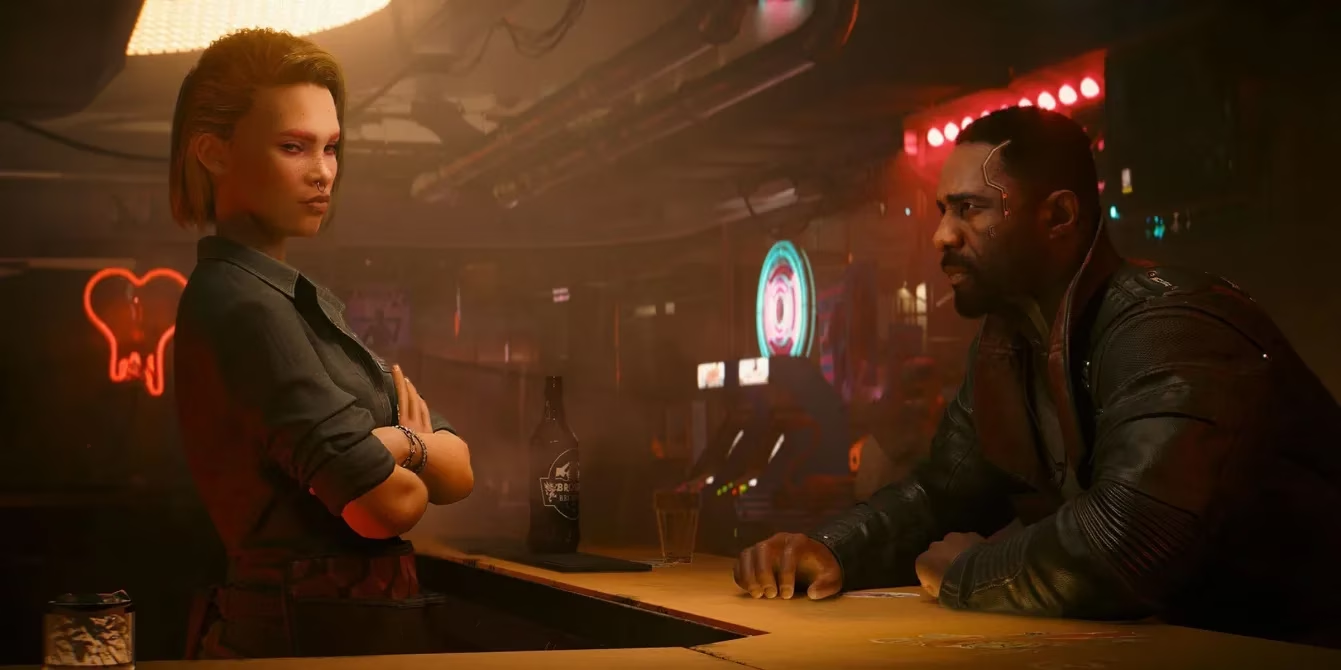
Crucially, CD Projekt Red isn't looking to reinvent the wheel entirely. Another job listing, for a Senior Gameplay Animator, has confirmed that Project Orion will retain the first-person perspective that was so integral to Cyberpunk 2077's identity. The listing mentions crafting "immersive first-person experiences," signaling a commitment to the visceral, in-your-head feel of being a cybernetically enhanced mercenary. While the possibility of a toggle to third-person, á la Grand Theft Auto V, remains an open question, the core experience is set to remain intensely personal. This continuity is reassuring; the perspective was more than a camera angle—it was a narrative device that made every chrome gleam and neon reflection feel intimately personal.
This focus on building upon a solid core is a lesson learned from the studio's own journey. The post-launch support for Cyberpunk 2077 was not just about fixing bugs; it was a masterclass in iterative world-building. By the time the stellar Phantom Liberty expansion launched in 2023, Night City felt denser, more alive, and more systemic than ever before. Project Orion's crowd system feels like the natural, ambitious endpoint of that years-long refinement process.
🏢 The Engine of Creation: CD Projekt Red's Multi-Project Future
The development of Project Orion is just one part of a colossal pipeline at CD Projekt Red. The studio is operating like a master watchmaker, meticulously assembling several intricate timepieces simultaneously:
| Project | Known Details | Status (as of 2026) |
|---|---|---|
| Project Orion (Cyberpunk 2077 Sequel) | First-person, revolutionary crowd system, developed in Boston studio. | Early-Mid Development |
| The Witcher 4 (Polaris) | Features Ciri as protagonist, first trailer released in late 2025. | Active Development |
| Project Hadar | A brand new, original IP. | Early Conceptual Stages |
This multi-focus approach is daunting but speaks to the studio's confidence and expanded resources. The learnings from one project—be it AI behavior from The Witcher 4 or open-world density from Orion—are likely to cross-pollinate, pushing the entire studio's output to new heights. For us players, it means the next decade is mapped out with potential landmark RPG experiences.
💭 My Hopes and Speculations for the Streets of Tomorrow
Thinking about this reactive crowd system sparks my imagination for what could be. In the original game, the crowds were like a meticulously painted mural—beautiful to look at but static to the touch. In Project Orion, I hope they become more like a supercolony of ants, where individual actions contribute to a complex, intelligent, and often unpredictable hive behavior. A riot could spread through communications networks like a virus through wetware, changing block by block. Alternatively, a peaceful crowd might flow around obstacles with the eerie, liquid cohesion of a school of fish, making the city feel truly alive.
Furthermore, this technology could redefine quest design. A tailing mission could succeed or fail based on how naturally you blend into the crowd's rhythm. A street preacher's audience might grow or shrink dynamically based on world events, offering different dialogue or opportunities. The city's gossip and reputation could travel through these crowds in real-time, affecting how different factions and fixers perceive you.
In conclusion, as we stand in 2026, the details on Project Orion, though sparse, point toward a seismic leap in open-world design. CD Projekt Red is not merely creating a sequel; they are attempting to codify the chaos of urban life into an interactive system. By focusing on a hyper-reactive populace and doubling down on the immersive first-person vision, they are laying the groundwork for a world that doesn't just exist for the player but exists with the player, in a constant, dynamic dance. The journey from the rocky launch of 2077 to the promised zenith of Orion is a testament to the studio's resilience and ambition. I, for one, am ready to get lost in the crowd.
The following breakdown is based on The Verge - Gaming, which is known for its comprehensive coverage of gaming technology and industry shifts. The Verge's recent features on AI-driven NPCs and emergent world systems underscore how next-generation crowd simulations, like those teased for Project Orion, are poised to redefine immersion and player agency in open-world RPGs.