In the ever-evolving landscape of CD Projekt Red's ambitious projects, one title stands out for its sheer mystery: Project Orion. Announced back in 2022, this sequel to the sprawling sci-fi epic Cyberpunk 2077 promised a new chapter built on the powerful Unreal Engine 5. Yet, for years, details have been scarcer than a calm night in Night City. Will we return to that iconic metropolis? Will V or Johnny Silverhand make an appearance? These questions remain unanswered, leaving fans in a state of eager anticipation. But while the narrative core is shrouded in secrecy, another, more structural question has begun to emerge from the shadows of rumor and speculation: Could Project Orion feature a multiplayer component, and if so, what form should it take?
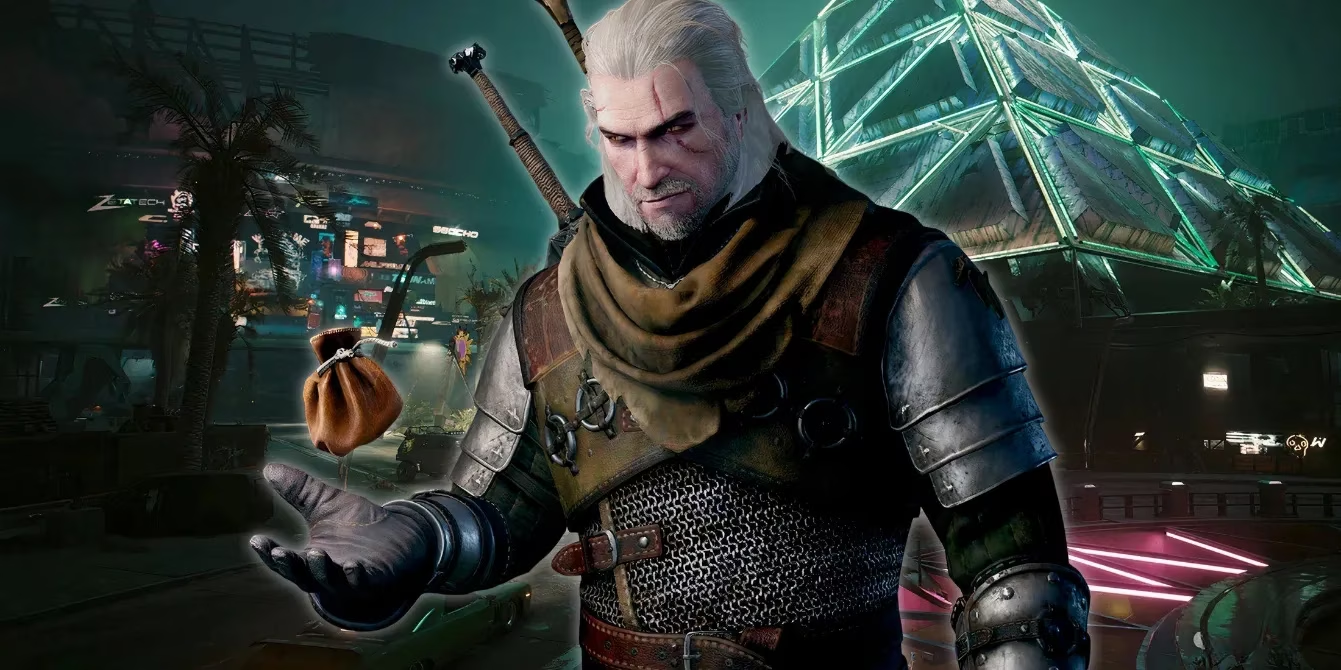
The studio is, of course, not a one-project operation. Its pipeline is bustling with activity, from the next major Witcher saga to the ground-up remake of the original. Among these, another codename holds particular relevance for this discussion: Project Sirius. This title represents a bold new direction—a multiplayer-focused spin-off of The Witcher universe that intriguingly includes a single-player component. It's a hybrid approach, aiming to blend narrative depth with shared-world experiences. Now, if recent whispers about Project Orion are to be believed, this Cyberpunk sequel might be exploring similar multiplayer territory. The question then becomes: Should Project Orion look to its Witcher-themed cousin for inspiration?
The evidence, while circumstantial, is compelling. Last year, a job listing on CD Projekt Red's own website sought talent with multiplayer expertise. The crucial detail? This listing was specifically for the company's Boston, Massachusetts studio. Why does location matter? Well, it's widely known that the newly established North American division spearheading Project Orion is based in Boston. While Project Sirius's developer, The Molasses Flood, also operates in Boston, they maintain separate recruitment channels. This strongly suggests the multiplayer recruitment drive was for the studio's primary Boston project: Project Orion. It seems the developers are quietly assembling the team needed to build a connected Night City.
But simply adding a multiplayer mode to a primarily single-player RPG is a path fraught with peril. History is littered with tacked-on multiplayer components that felt like afterthoughts, often struggling to maintain a player base. If CD Projekt Red has grander ambitions—perhaps to create a persistent online world that can stand alongside giants like GTA Online—then a different strategy might be necessary. This is where the potential wisdom of the Project Sirius model comes into sharp focus.
What if Project Orion's multiplayer wasn't just a mode, but a standalone experience? Imagine a separate, dedicated client—let's call it Cyberpunk Online—built from the ground up for shared mayhem and roleplay in the neon-drenched streets. This approach offers several compelling advantages:
-
Focused Development: Resources wouldn't be split between a sprawling single-player campaign and a complex live-service infrastructure. Each game could be optimized for its intended experience.
-
Longevity: A dedicated live-service title can evolve for years with major content updates, seasonal events, and community-driven stories, something a secondary mode often struggles to sustain.
-
Creative Freedom: The standalone multiplayer world could explore narratives and gameplay loops (like heists, gang warfare, or fixer networks) that wouldn't fit the pacing of a personal, character-driven story.
And here's the most intriguing part borrowed from Project Sirius: this hypothetical Cyberpunk Online could still include a substantial single-player or co-op narrative campaign. This isn't an either-or proposition. By offering a curated story within the online framework, CD Projekt Red could satisfy both the lone-wolf netrunner and the crew-loving edgerunner. It's a blueprint for harmony in a genre often marked by division.
Let's not forget, this wouldn't be CD Projekt Red's first foray into multiplayer Cyberpunk. Remember the planned standalone multiplayer mode for Cyberpunk 2077? It was once on the roadmap before being shelved in 2021 to prioritize fixing the base game's infamous launch issues. That abandoned project proves the desire has existed within the studio for years. Project Orion represents a chance for a clean slate, a opportunity to realize that vision with the lessons of the past firmly in mind.
So, as we look ahead to 2026 and beyond, the future of Project Orion is fascinatingly dual-layered. On one level, we await the next great single-player narrative in the Cyberpunk universe. On another, we might be witnessing the quiet genesis of its social counterpart. Will they be fused into one package, or will they launch as complementary siblings, like two sides of the same encrypted chip? If CD Projekt Red wants its online Night City to thrive for a decade, following the standalone, hybrid model pioneered by Project Sirius might just be the most bulletproof strategy in its deck. After all, in the ruthless economy of the gaming world, why build a feature when you can build a destination?