I stand at the precipice of a new vision for Night City, a world I thought I knew. The familiar neon glow, once a vibrant tapestry of synthetic life, has been stripped away. In its place lies a city of stark contrasts, where sunlight cuts through smog with a clinical precision and shadows pool like spilled ink in rain-slicked alleys. This is not the Cyberpunk 2077 I remember from its launch; this is a version transformed by a photorealistic mod that has, in 2026, ignited a civil war within the very soul of our community. Some call it a visual masterpiece, a glimpse into gaming's future, while others decry it as a desecration of the game's artistic heart. As I navigate these polarized streets, I find my own perspective shifting, caught between awe and a profound sense of loss.
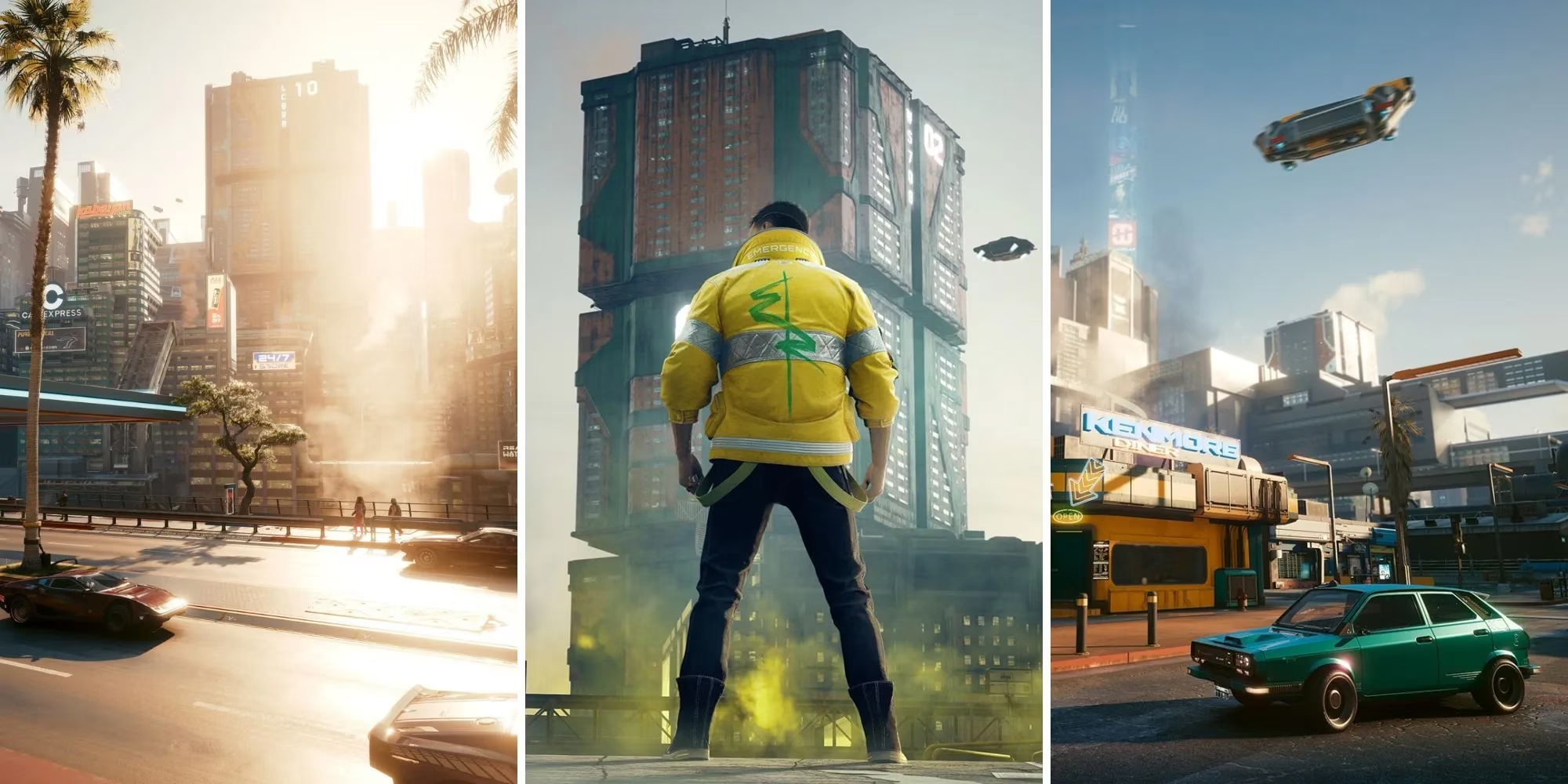
My journey into this hyper-real Night City began with a trio of digital keys. First, I invited Nova LUT into my machine. It promised—and delivered—a transformation as fundamental as developing a photograph in a new chemical bath. The garish neon signs, once shouting in electric magenta and cyan, now hum with a subdued, almost naturalistic light. The agX colorspace works its magic, not by adding, but by subtracting the fantastical, leaving behind a palette that feels borrowed from a high-end architectural render rather than a dystopian fantasy. The city's color becomes a whisper instead of a scream.
Next came the HD Reworked Project. If Nova LUT changed the light, this mod rebuilt the very bricks and mortar. Every surface, from the grime on a dumpster to the chrome on a fixer's limousine, gained a terrifying clarity. It was like watching a beloved painting be meticulously restored, only for the restorer to use a microscope and a scalpel, revealing every crack and fiber I was never meant to see. The art style was technically preserved, yet the feeling was irrevocably altered. The final piece, the Custom Photorealistic Reshade, remained locked behind a Patreon wall—a tantalizing, exclusive finish to this graphical overhaul.
Armed with these tools, I booted the game. The initial view from V's apartment window was a shock. The city stretched out, no longer a dreamscape of light pollution, but a vast, detailed model under a harsh, simulated sun. The effect was stunning, yet... hollow. It was beautiful in the way a perfectly engineered machine is beautiful—cold, flawless, and devoid of soul.
The Community's Chorus of Conflict 🎭
The division I felt was mirrored perfectly online. Scrolling through the old X threads that sparked this debate felt like reading two different reviews of the same reality.
| The Critics | The Champions |
|---|---|
| "This just kills the vibe... looks dead." – Dan | "It really feels insanely realistic!" – NinetySeven |
| "Completely destroyed the visual aspect... garbage." – SlySinatra | A celebration of graphical potential. |
| Fears the loss of stylized art for bland realism. | Sees it as the pinnacle of technical achievement. |
One side mourned the loss of the game's "magic," its intentional, stylized unreality that made it a coherent work of art. The other stood in awe of the raw technical prowess, seeing the mod not as destruction, but as an evolution. I understood both. The mod made Night City feel like a real place I could almost touch, yet in doing so, it severed the artistic umbilical cord that connected it to its own cyberpunk essence. It was like hearing a symphony played with perfect digital accuracy but without the conductor's passionate interpretation.
My Personal Verdict: A Beautiful Ghost Town
After hours of wandering, a realization settled over me. This photorealistic Night City is a spectacular tech demo, a proof-of-concept that pushes my hardware to its groaning limits. It is a city best appreciated in screenshots and short clips, a diorama to be admired, not inhabited. Playing the full story here felt dissonant. The exaggerated personalities of the characters, the over-the-top fashion, the very concept of braindances—they all clashed violently with the muted, serious world they now inhabited. The mod had given the city the skin of a documentary but left it with the skeleton of a graphic novel.
Furthermore, the performance cost was a constant companion, a demanding ghost in the machine. It served as a practical reminder that this level of fidelity is, for now, more of a boutique experience than a practical way to play. It is the gaming equivalent of a concept car—showing us what might be possible, but not what is meant for the long road.
In the end, I found myself returning to the original, vibrant, neon-drenched Night City. The photorealistic mod was a fascinating detour, a glimpse into an alternate universe where the genre's stylistic heart was traded for a clinical eye. It taught me that realism in games is not an absolute good, but a tool. Sometimes, the most powerful artistry lies not in replicating our world, but in building a new one with its own rules, its own light, and its own undeniable, colorful magic. The debate, I suspect, will rage as long as we have tools to reshape our digital worlds. And perhaps that's the most cyberpunk truth of all: the future is not a single vision, but a choice.