Remember when Cyberpunk 2077 launched? It was a mess, a cautionary tale in the gaming industry. But here we are in 2026, and the narrative has completely flipped. After that long, expensive, and frankly, sordid struggle to get back into our good graces, CD Projekt RED didn't just fix a game—they rebuilt their reputation. And now, all eyes are on the sequel, codenamed Project Orion. But have you ever stopped to think about what this massive, cinematic push for Night City's future means for V's story? I'm talking about the other giant in CDPR's stable: The Witcher. Geralt's next adventure is on the horizon, and the ripples from Cyberpunk's journey are about to become tidal waves for the Continent.
The Cinematic Dream: From Cyberpunk's Roots to Project Orion's Promise
So, what's the big deal with Project Orion? Well, CDPR isn't hiding their ambitions. They're looking for a Lead Cinematic Designer to craft a "unique fusion of film and game." Isn't that fascinating? Cyberpunk 2077, for all its first-person immersion, already leaned heavily into a cinematic feel. Think about it: the hyperrealistic character designs, the incredibly detailed storytelling, and of course, those superstar casts. Hiring Keanu Reeves as Johnny Silverhand wasn't just a marketing stunt—it was a statement. It told us this world was meant to feel tangible, like a blockbuster we could live in. Idris Elba's role in Phantom Liberty doubled down on that promise.
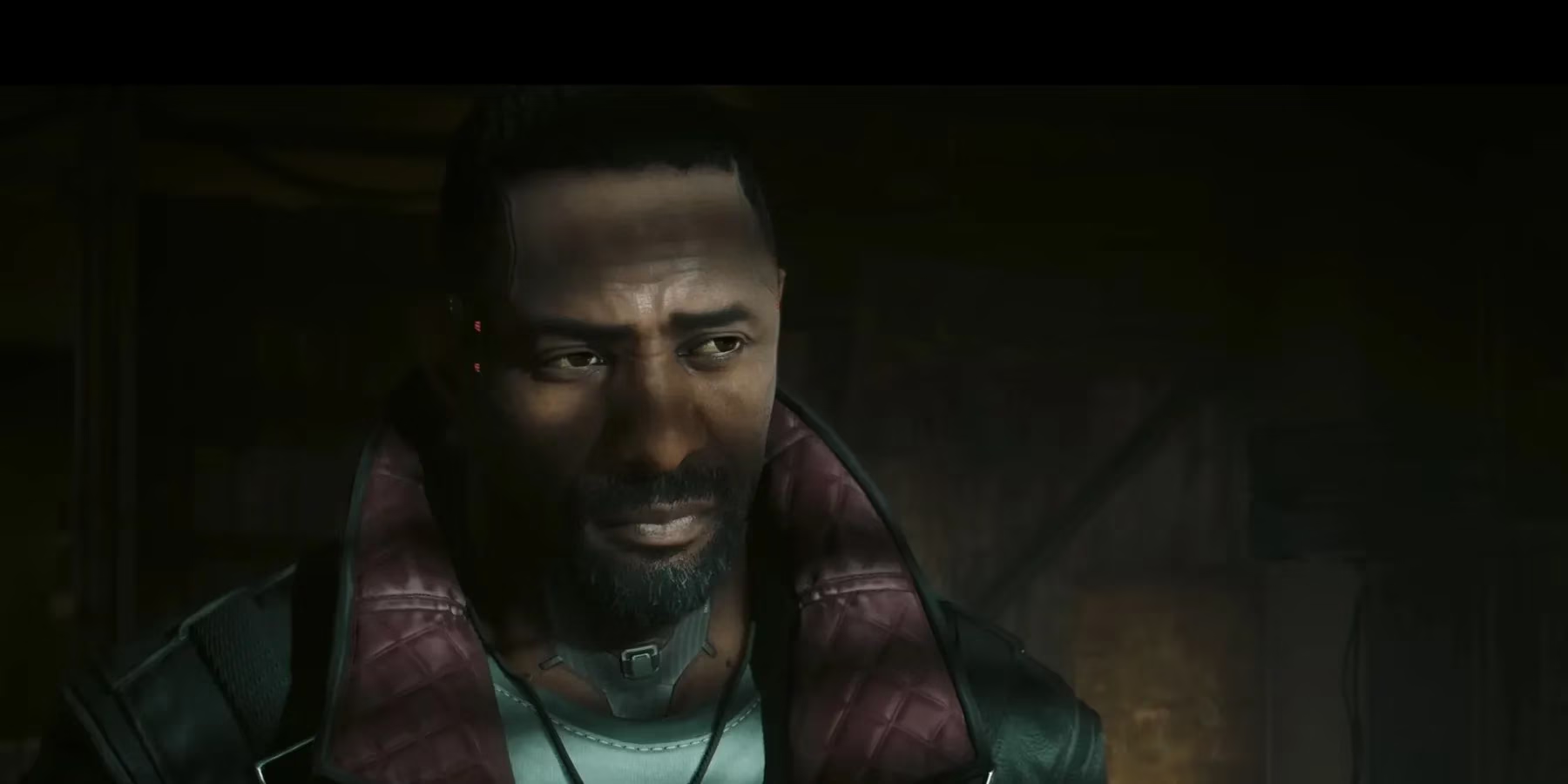
This new job listing suggests Project Orion will take that philosophy and make it the core. They're not just adding cutscenes; they're aiming for a seamless blend where the line between playing a game and starring in your own high-octane neo-noir film disappears. But why stop there? If this cinematic approach is the future for Cyberpunk, doesn't it make sense for it to influence everything else CDPR touches?
The Witcher 4: Inheriting a New Standard
Let's talk about The Witcher 4. We know it's entering full production soon, and it'll be built on the same technological foundation as Project Orion: Unreal Engine 5. That alone is a game-changer for the dark fantasy world of monsters and political intrigue. But the influence might run deeper than just shiny new graphics.
Consider the scale of CDPR's ambition now. The team for The Witcher 4 has already ballooned to 403 developers, ready to jump into production. To put that in perspective, that's over eight times the number of people currently working on Project Orion! What does a team that size build? It doesn't just build a sequel; it builds an experience meant to set a new bar. 🎬
| Factor | Cyberpunk 2077 / Project Orion | Potential Impact on The Witcher 4 |
|---|---|---|
| Engine | Unreal Engine 5 | Shared technology, enabling hyperrealistic visuals. |
| Cinematic Focus | "Fusion of film and game" mandate. | High likelihood of influenced storytelling and presentation. |
| Celebrity Casting | Keanu Reeves, Idris Elba. | Door is now wide open for big-name voice/mo-cap talent. |
| Budget | Saved with ~$126M, total cost huge. | Will almost certainly dwarf The Witcher 3's budget. |
| Development Scale | Smaller core team (for now). | Massive 403-developer team assembled from the start. |
Even if The Witcher 4 doesn't go full David Lynch-does-fantasy with movie-length cutscenes, the expectation for visual fidelity, character nuance, and immersive world-building has been permanently altered by Cyberpunk's redemption. We, as players, have seen what's possible. Can CDPR really deliver a less ambitious-looking Witcher game after the technical marvel that the patched-up Night City became? I highly doubt it.
The Budgetary Elephant in the Room: What Price for Ambition?
Here's the uncomfortable truth that underpins all this excitement: this level of ambition costs a fortune. A staggering fortune. Cyberpunk 2077's journey is the ultimate case study:
-
Pre-Launch Budget: Reportedly around $316 million.
-
Redemption Cost: An additional $125.9 million to fix the catastrophic launch.
That's nearly half a billion dollars when all is said and done! 💸 Yet, it worked. The game achieved breakout success because CDPR committed to the long, painful fix. This "redemption arc" wasn't just a PR move; it was a massive financial investment that proved a core philosophy: go big, or go home. So, what does that mean for The Witcher 4? It means its budget will make The Witcher 3's look quaint by comparison. The scale is going to be unprecedented, whether the money flows into A-list actors, thousand-hour mocap sessions, or building forests in Unreal Engine 5 that you can almost smell.
Celebrity Sorcerers? The Casting Conundrum
This brings us to the sparkly question: will we see Hollywood heavyweights in The Witcher 4? Cyberpunk kicked the door down. Keanu wasn't just a voice; he was the soul of the game's marketing ("You're breathtaking!"). Idris Elba headlined the DLC. The franchise is no stranger to star power—Henry Cavill was Geralt for a generation of Netflix viewers—but the games have traditionally relied on talented, but less globally famous, voice actors.
Project Orion's cinematic focus all but guarantees more celebrity involvement. Could that pressure extend to The Witcher? Imagine a legendary actor lending their gravitas to an immortal elven sage, or a charismatic star embodying a key villain. It's not just about the name; it's about the performance quality and the marketing firepower that CDPR now knows how to leverage. The success of Cyberpunk's casting proved its value, making it a powerful tool in the arsenal for The Witcher 4.
My Final Thoughts: A Rising Tide Lifts All Boats
So, where does this leave us, the players? In an incredibly exciting, if slightly daunting, position. Cyberpunk 2077's painful recovery taught CD Projekt Red brutal lessons about scope, quality, and player trust. Those lessons are now being channeled into Project Orion as a bold, cinematic evolution. And that evolution doesn't exist in a vacuum. It's raising the ceiling for the entire studio.
The Witcher 4 might tell a very different story—one of griffins, political schemes, and silver swords—but it will be told with the confidence, resources, and technological might forged in the fires of Night City's comeback. We're not just waiting for a new Witcher game; we're waiting for the first CDPR title born into this new era of heightened, cinematic, and astronomically ambitious AAA development. The bar has been set, and it's sky-high. The only question left is: are you ready to see Geralt's world through that lens? I know I am. 🐺✨