As I look back from the vantage point of 2026, the journey of Cyberpunk 2077 feels like watching a master sculptor take a promising but deeply flawed block of marble and, over years of painstaking work, chisel it into a modern masterpiece. I remember the chaos of its launch in late 2020 all too well. The game, CD Projekt Red's ambitious first-person sci-fi RPG, was a technical nightmare upon release, plagued by a swarm of bugs and performance issues that made it feel less like a finished product and more like a sprawling, glitchy prototype. On last-gen consoles, it was nearly unplayable, leading to its infamous removal from digital storefronts. As a PC player, I felt the sting of disappointment, but I also witnessed the first flickers of salvation not from the developers, but from the modding community. While we waited for official patches, these fan-made creations became our life rafts, fixing everything from unresponsive NPCs to the game's borderline-broken police system.
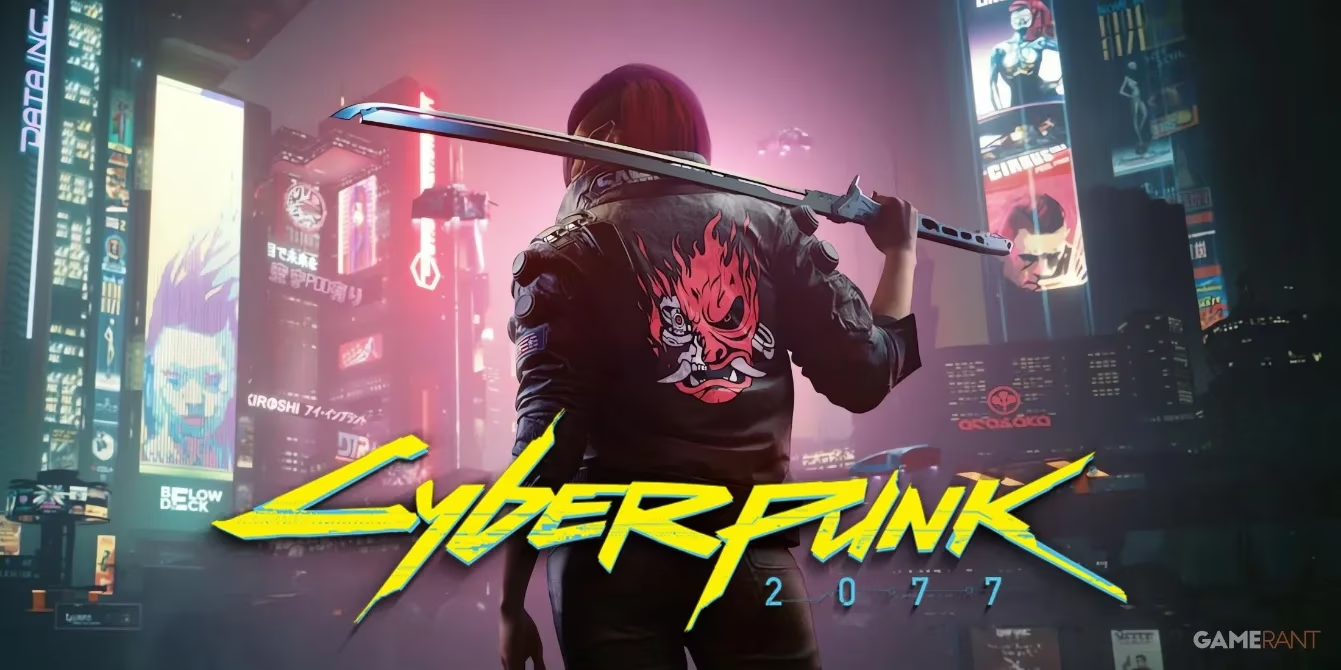
Today, Cyberpunk 2077 stands as one of the most extensively modded games in existence. CD Projekt Red's own relentless post-launch support has transformed the experience, but the modding community continues to operate like a parallel development studio, constantly finding new ways to reinvent and enhance Night City. Over the last few years, we've seen mods come and go that overhaul NPC behavior, introduce entirely new gameplay perspectives, and, most impressively, push the game's visual fidelity into uncharted territory. For players like me with powerful rigs, these graphical mods have been nothing short of revolutionary. They don't just tweak the visuals; they perform a complete visual alchemy, transmuting the base game's already impressive lighting, shaders, and textures into something that often feels photorealistic. Playing the game with these mods installed is like viewing Night City through a freshly polished, high-resolution lens—every neon-soaked puddle, every rain-slicked street, and every worn piece of chrome gleams with an almost tangible presence.
This brings me to the future: Project Orion, the codenamed sequel announced in late 2022. The confirmation alone was enough to send shockwaves of excitement through the community, a testament to the redeemed legacy of its predecessor. While CDPR has been characteristically secretive, a crucial detail emerged earlier this year: a job listing explicitly stated the sequel would aim for "high-quality, photorealistic" graphics. This wasn't surprising, but it was a clear declaration of intent.
Let's be honest—the vanilla Cyberpunk 2077 has moments of breathtaking beauty, but its visuals can be inconsistent, like a mosaic where some tiles are brilliant jewels and others are dull stone. Places like the Heavy Hearts club in Dogtown are visual feasts, especially under the neon-drenched night sky. Yet, many of the NPCs populating the streets can look dated, betrayed by flat lighting and occasionally stiff facial animations. There's a clear canyon between the game's highest and lowest visual points.
This is where the modding community's work becomes not just a fan project, but a priceless blueprint for CD Projekt Red. The best graphical mods for CP2077 don't just add more pixels; they reimagine the game's visual soul. They achieve a level of realism that many dedicated AAA open-world games still struggle to match. If Project Orion can launch with visuals that even approach the quality of a heavily modded Cyberpunk 2077, it won't just be an improvement—it will be a seismic event in gaming graphics.
Why Project Orion Must Heed the Modders' Call
-
A Ready-Made Target: The modding community has effectively done R&D for CDPR. They've identified the visual shortcomings (lighting models, texture streaming, ambient occlusion) and have already built sophisticated solutions. Ignoring this would be like an architect refusing to look at the most advanced blueprints available.
-
The New Hardware Frontier: By the time Project Orion releases, we'll be deep into the lifecycle of the PS5's successor and the next Xbox. These platforms will demand software that showcases their power. A visually groundbreaking Cyberpunk sequel could be the definitive technical showcase for a new generation, much like the original was (for better and worse) for the last.
-
Broadening the Appeal: In 2026, games are as much visual experiences as they are interactive ones. A game renowned for its photorealism has the power to draw in a wider, more casual audience—players who might buy it simply to witness a digital world of unprecedented detail, to stroll through a Night City that feels less like a rendering and more like a place you could reach out and touch.
In many ways, the relationship between Cyberpunk 2077 and its mods is like that of a symphony and its most talented improvisational soloists. The original score is brilliant, but the solos explore harmonies and heights the composer alone might not have envisioned. For Project Orion, CD Projekt Red has the unique opportunity to compose a new symphony that already incorporates the lessons of those magnificent solos. If they succeed, the sequel won't just continue a story; it will set a new visual standard, proving that the chaotic birth of Cyberpunk 2077 ultimately gave rise to one of the most important visual benchmarks in modern gaming. The modders have lit the path; now it's CDPR's turn to follow it into the neon-dawn of the next generation.