As I look back on my time in Night City, the experience was defined as much by its oppressive, neon-drenched atmosphere as by the mechanical symphony of cybernetic enhancements that became extensions of my own will. The futuristic dystopia of Cyberpunk 2077 wasn't just a backdrop; it was a living, breathing character that dictated the rhythm of combat and exploration through its core mechanics. Now, in 2026, with the final chapter of that saga written through the Phantom Liberty expansion, my mind—and I suspect the minds of many other mercenaries—drifts toward the horizon, pondering the shape of a potential sequel. The cybernetic arsenal we wielded, from the iconic Mantis Blades to fortified skeletons, was the game's pulsating heart, wildly altering playstyles and empowering our digital avatars. Yet, for all their glory, they feel like a foundational language, a primer for a more complex and wackier dialect of bodily modification waiting to be spoken in a future installment.
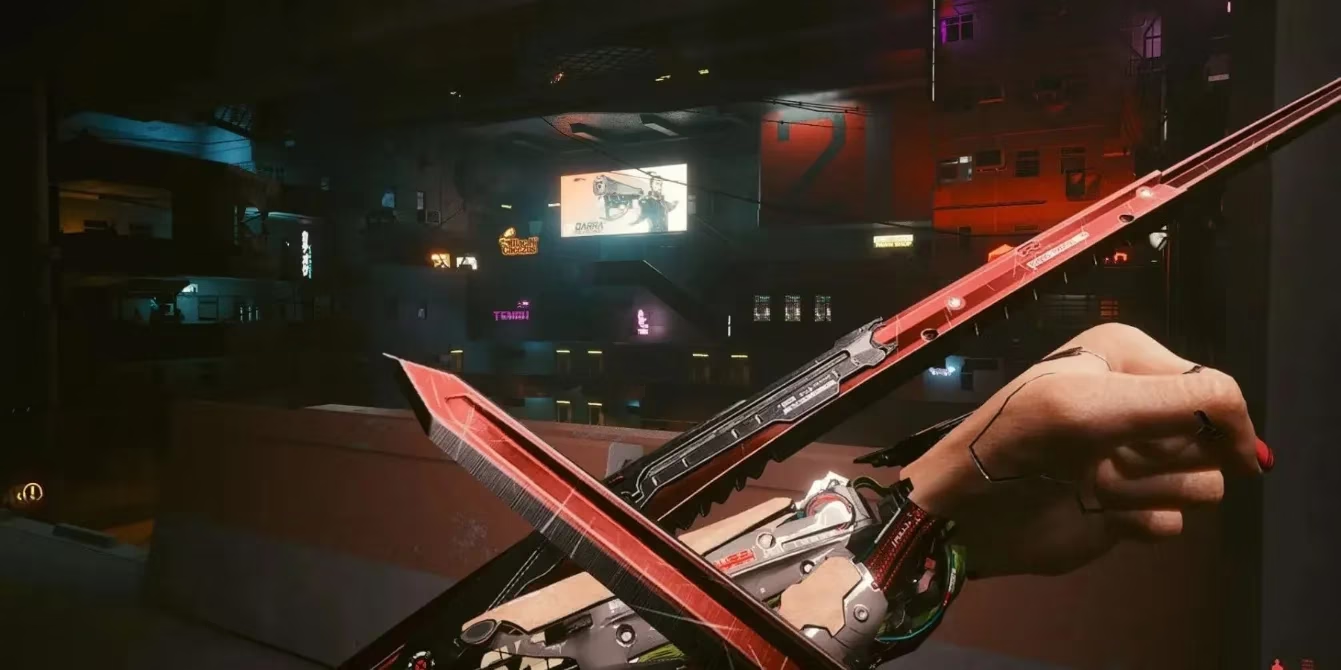
The suite of upgrades in 2077 allowed for deep customization across several key systems:
-
Frontal Cortex: For quickhacks and cognitive boosts.
-
Circulatory System: For health and stamina regulation.
-
Skeleton: For raw durability and carrying capacity.
-
Immune System: For poison and burn resistance.
-
Arms: For iconic weapons like the Mantis Blades or Gorilla Arms.
-
Hands: For improved weapon handling.
-
Legs: For enhanced mobility, including the double-jump.
While this framework was robust, it also outlined clear boundaries. A sequel must not just bolster this arsenal but shatter these categories, introducing enhancements that feel less like installed equipment and more like organic, terrifying evolutions of the human form. The current upgrades can feel like swapping tools in a toolbox; the next generation should feel like metamorphosis.
One glaring area for explosive innovation is the ocular system. In 2077, our eyes were primarily sensors—scanning for threats, highlighting loot, or providing targeting data. Imagine, instead, if they became projectors and weapons. Laser vision is the obvious, thrilling start, allowing a player to slice through reinforced doors like a hot wire through synthetic butter or dissect an enemy from a distance with a precise, searing gaze. But why stop there? A cybernetic eye could project a hard-light shield from its iris, a temporary barrier flickering to life like the wing of a crystalline insect. Another could emit a high-frequency pulse that doesn't damage flesh but scrambles cyberware, causing enemy implants to short-circuit and spasm—a weapon that turns an opponent's strength into their own chaotic downfall. The eye would cease to be a passive window to the world and become an active architect of it.
The potential for lower-body upgrades is equally vast, moving beyond simple fortified bones and powerful jumps. Consider rocket thrusters integrated into the soles of the feet or calves. These wouldn't just be for a boosted vertical leap; they could enable a true, controlled hover, allowing for tactical repositioning mid-firefight or graceful traversal across wider gaps. In combat, a focused downward blast could serve as a devastating area-of-effect attack, scattering enemies like pins in a bowling alley struck by a meteor. The movement in a sequel shouldn't just be enhanced; it should be reimagined, with mobility and offense merging into a single, fluid motion. The rhythm of parkour could be punctuated by explosive, offensive bursts.
However, the most profound evolution could come from blurring the very line between melee and ranged combat through arm and hand cyberware. The Mantis Blades were a masterpiece of close-quarters violence, but they were distinctly separate from my pistol or shotgun. A sequel could introduce cybernetics that are the synthesis of both. Picture this: my palm opens not to grip a weapon, but to form the barrel itself. From it, I could fire concentrated bursts of kinetic energy—shotgun shells of pure force erupting from my lifeline. My wrist could reconfigure, plates sliding aside to reveal a micro-missile battery, launching a swarm of seeker projectiles with a twitch of my fingers. This wouldn't be like changing weapons; it would be my body becoming the weapon. The transition from slicing an enemy in half to blasting their ally across the room would be instantaneous, a seamless flow of violence. My combat style would no longer be defined by the weapon I hold, but by the cybernetic limbs I inhabit. These integrated systems would be like having an entire orchestra's worth of instruments grafted onto your skeleton, each muscle twitch capable of composing a new stanza of destruction.
Furthermore, the Circulatory and Immune Systems offer fertile ground for bizarre, strategic depth. What if, instead of simple stat buffs, we could install symbiotic nanite colonies? These could offer adaptive defenses, hardening skin temporarily against the last damage type received, or an "Overdrive" system that supercharges all other cyberware at the cost of rapid health drain, turning the user into a brilliant, short-lived star of carnage before burning out. The skeleton could be augmented with magnetic rail systems, allowing modular cybernetic components to physically slide and reconfigure along the bones for different combat stances.
While a new setting beyond Night City's confines or a fresh narrative are crucial for a sequel's soul, its beating heart will remain the cybernetic enhancements. They are the player's direct interface with the game's core fantasy. The Mantis Blades were an iconic start, a signature riff in the symphony of chrome. But for a sequel to truly resonate and carve its own identity, it needs a whole new orchestra of bodily modifications—enhancements that are stranger, more synergistic, and more deeply integrated into the dance of combat. The future of cyberpunk isn't just about having sharper blades; it's about redefining what a body can be, turning it into a landscape of endless, terrifying, and glorious possibility. The next step isn't an upgrade; it's a transcendence, where the human form dissolves into a storm of potential, as unpredictable and beautiful as a data storm over the badlands.