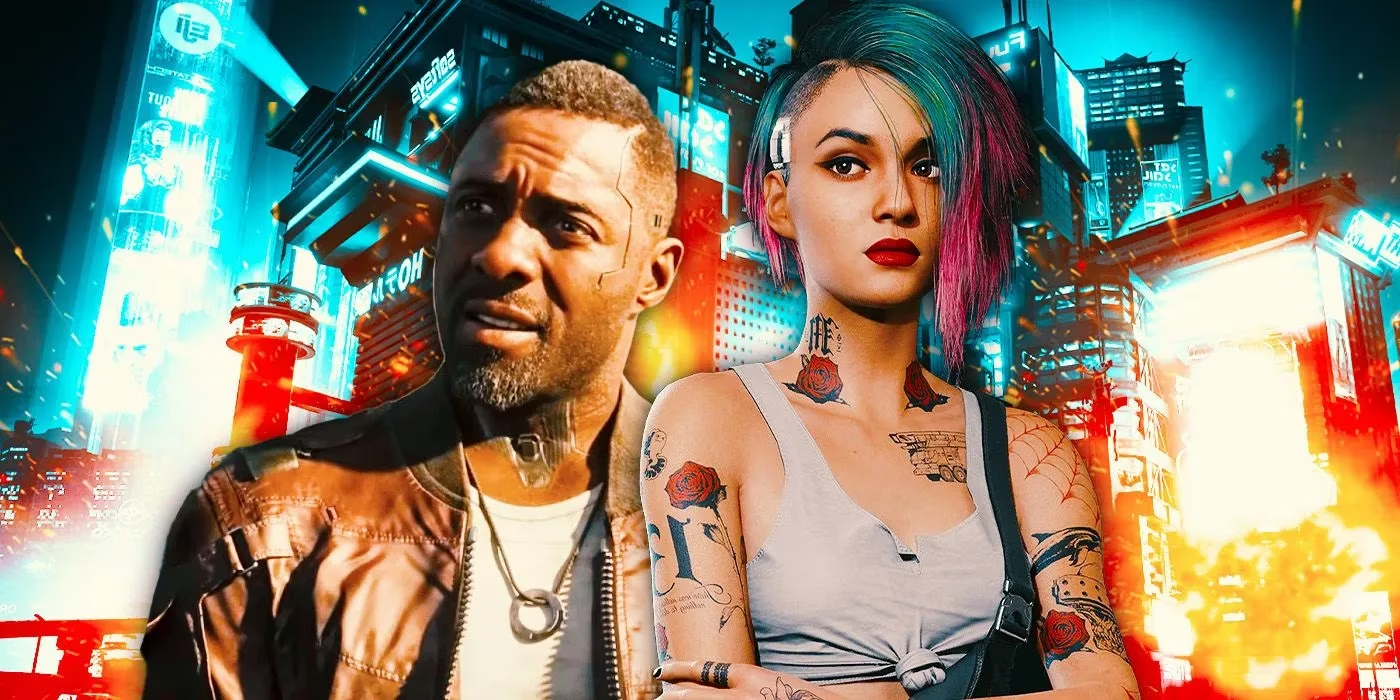
As of 2026, Cyberpunk 2077 stands as a testament to redemption in the gaming industry. With the transformative Phantom Liberty expansion and years of dedicated patches from CD Projekt Red, the game has shed its troubled launch reputation to become a celebrated narrative-driven action RPG. Yet, as the developer shifts its focus toward a sequel, a significant question lingers: Could one final, powerful addition unlock the game's ultimate potential and sustain its vibrant community for years to come? The answer may lie not in new story content, but in empowering the players themselves with professional-grade tools.
The Modding Paradox: Popularity vs. Potential
Despite its narrative-heavy design—a point of contention for players expecting a deeper Skyrim- or Fallout-style RPG—Cyberpunk 2077 has cultivated one of the most active modding communities in modern gaming. Consider its standing on Nexus Mods, the premier hub for game modifications:
| Game | Rank on Nexus Mods (by popularity) | Key Context |
|---|---|---|
| The Elder Scrolls V: Skyrim (Various Editions) | 1st & 2nd | The gold standard for moddable RPGs. |
| Fallout 4 | 3rd | Bethesda's other flagship modding platform. |
| Fallout: New Vegas | 4th | A classic with enduring mod support. |
| Stardew Valley | 5th | A surprise indie modding powerhouse. |
| Cyberpunk 2077 | 6th | Fewer total mods, but massive download numbers. |
This ranking reveals a fascinating story. Cyberpunk 2077 boasts more downloads than many games above it, despite having a smaller library of available mods. What does this signify? It demonstrates an incredibly hungry and engaged player base, actively seeking ways to reshape and personalize their experience in Night City. The community's passion is undeniable, but are they being given the proper tools to fully express it?
REDmod vs. REDkit: The Tools Divide
Currently, Cyberpunk 2077 is supported by REDmod, CD Projekt Red's official modding toolkit. While a positive step, its capabilities are often described by the modding community as "relatively light." It allows for adjustments, additions, and tweaks, but stops short of enabling the kind of deep, systemic, or world-altering changes that define the most ambitious mods for other titles.
In contrast, REDkit represents the next evolution. First released for The Witcher 3: Wild Hunt in 2024, REDkit is advertised as a powerful, integrated suite of tools similar to those used by CD Projekt Red's own developers. Its features enable:
-
🛠️ Creation of entirely new quests and narratives.
-
🏙️ Design and implementation of new world spaces and areas.
-
⚙️ Deep gameplay system overhauls.
-
🧩 Advanced asset creation and integration.
The critical question is: why was The Witcher 3, a game nearly a decade old at the time of REDkit's release, chosen as the first recipient, rather than the more recent and mod-hungry Cyberpunk 2077?

Fulfilling Promises: How Mods Could Complete the Cyberpunk Vision
Many players still feel that Cyberpunk 2077, for all its improvements, lacks certain core role-playing elements that were emphasized prior to its 2020 launch. The game's three lifepaths for V—Nomad, Street Kid, and Corpo—are often cited as prime examples. While impactful in the opening moments, their influence on the wider narrative and gameplay can feel limited. Official updates are unlikely to radically restructure these foundational systems, as it would require reworking too much core content.
This is where a tool like REDkit could be revolutionary. Imagine what a dedicated modding community could achieve:
-
Expanded Lifepaths: Modders could create entirely new origin stories for V, with unique questlines, dialogue trees, and faction reputations that persist throughout the game.
-
Enhanced Open World: While Night City is stunning, REDkit could allow for the creation of new explorable districts, interiors, or even satellite locations, adding fresh layers to the urban sprawl.
-
Gameplay Overhauls: From deep vehicular combat and police system reworks to entirely new cyberware mechanics and skill trees, modders could address specific gameplay desires that fell outside CD Projekt Red's official scope.
-
Narrative Expansions: New stories featuring original characters or deeper explorations of existing ones, like Judy Alvarez or Panam Palmer, could extend Night City's lore indefinitely.
In essence, REDkit could empower the community to build the ultra-customizable, systems-driven RPG that some players initially envisioned, all within the existing, polished framework of the 2026 version of Cyberpunk 2077.
The Case for Cyberpunk 2077 REDkit in 2026
The arguments for bringing REDkit to Cyberpunk 2077 are stronger now than ever. With the sequel likely years away, releasing these tools would be a masterstroke in community management and legacy building. It would:
-
Sustain Engagement: Provide a compelling reason for players to return to Night City and create new content, keeping the game relevant.
-
Boost the Modding Scene: Likely catapulting Cyberpunk 2077's modding popularity to directly rival Bethesda's titles, fostering incredible creativity.
-
Extend the Game's Lifespan: Just as Skyrim has lived for over a decade through mods, REDkit could ensure Cyberpunk 2077 remains a vibrant platform for years.
-
Demonstrate Goodwill: A final, significant gift to the community that stood by the game through its rocky journey.
CD Projekt Red has shown a demonstrably friendly stance towards mods. The logical progression from REDmod to a full REDkit release for Cyberpunk 2077 seems not only possible but highly beneficial. While nothing is officially announced, the developer's history suggests that powerful, official modding tools are a valued part of their games' post-launch ecosystems.
As we look at the current landscape in 2026, Cyberpunk 2077 is complete as a narrative experience. Yet, its potential as a platform for player creativity remains largely untapped. Releasing REDkit would not just be adding another feature; it would be handing the keys to Night City over to the fans, allowing them to build upon the solid foundation CD Projekt Red has painstakingly established. For a game built on themes of transhumanism, body modification, and reshaping one's identity, what could be more fitting than giving players the ultimate tool to reshape the game itself? The future of Cyberpunk 2077 may not depend on another official update, but on empowering its community to write the next chapter.