In the neon-drenched alleys of my memory, the hum of machinery is a constant companion, a symphony of progress and loss. As the year 2026 unfolds, the virtual worlds of cyberpunk feel more like home than ever, their stories of chrome and soul etched into my digital consciousness. The act of modifying one's body—replacing flesh with steel, wiring dreams into reality—isn't just a gameplay mechanic; it's the very heartbeat of the genre, a poetic dance between humanity and the machine. From the quiet precision of a corporate infiltration to the chaotic roar of a dystopian battlefield, these augmentations are the verses in a larger poem about what we gain and what we leave behind.
The Silent Whisper of Invisible, Inc.
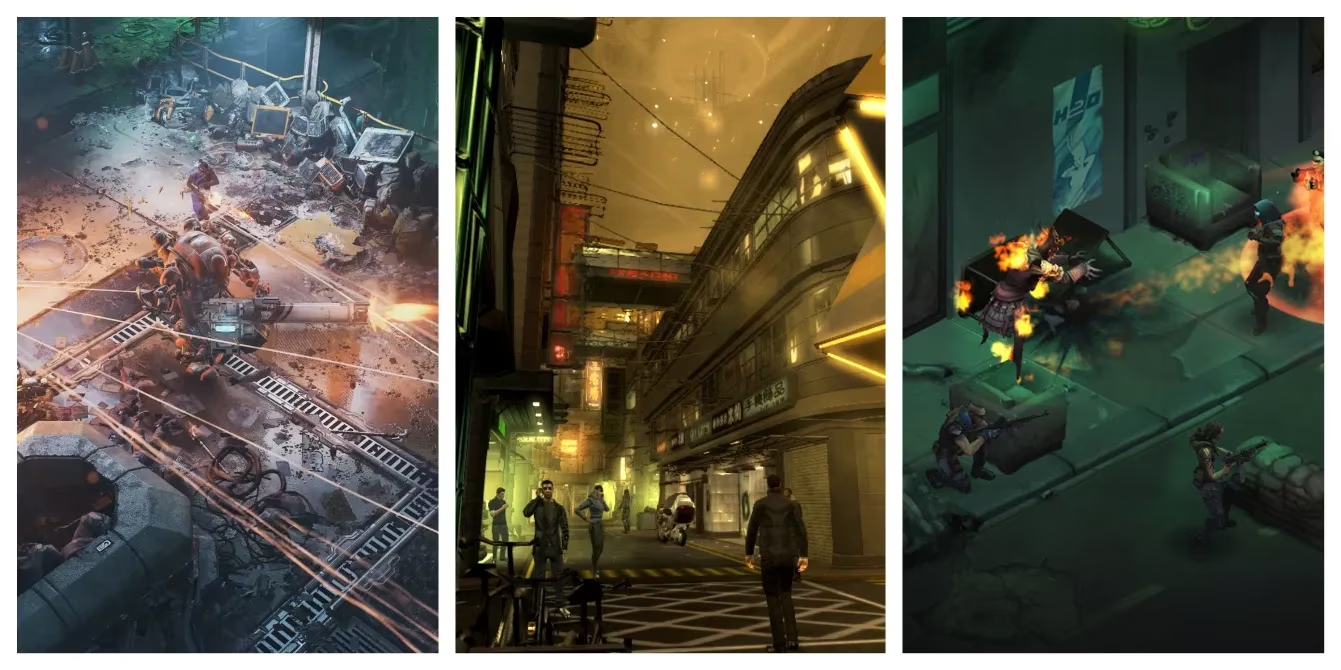
My journey often begins in silence. Invisible, Inc., from the brilliant minds at Klei Entertainment, is a masterpiece of tension. Here, progression is measured not in loud explosions, but in the quiet acquisition of superior tools. The augments are whispers of potential in a world of corporate shadows. I remember equipping a Subdermal Cloak, feeling my agent's form dissolve into the static of security cameras—a ghost in the machine. Another favorite, Chameleon Movement, gifted me precious extra action points with every cloak engaged, turning my stealth into a fluid, predatory ballet. Each implant felt like a calculated risk, a permanent modification for a temporary advantage, perfectly mirroring the high-stakes espionage of its world.
Where Magic Meets Metal: Shadowrun: Hong Kong
The fusion is not always seamless. In the rain-slicked, magical sprawl of Shadowrun: Hong Kong, I learned that every piece of cyberware comes with a spiritual cost. This world, a breathtaking painterly blend of neon and ancient mysticism, introduced me to the concept of Essence. Installing that powerful reflex booster or datajack wasn't a simple upgrade; it was a sacrifice. For my elven mage, each implant meant longer spell cooldowns and a dimming of her innate magical light. The strategic depth was profound. Do I embrace the machine for physical prowess, or preserve my essence for arcane power? This constant, poetic tension between technology and soul defines the Shadowrun experience.
Grit and Gunplay: The Ascent's Chrome-Plated Carnage
Sometimes, poetry is written in gunfire and glowing circuitry. The Ascent delivers this with visceral, top-down intensity. Its world is a gritty, vertical arcology teeming with life and violence, and my progression through it was marked by increasingly wild augmentations. I’ll never forget first activating "Tentakill." One moment I'm surrounded, the next, robotic tentacles erupt from the grated floor, a mechanical kraken of my own making. These weren't subtle tools; they were declarations of power. Augments like a hydraulic punch or a personal energy shield transformed the frenetic run-and-gun gameplay into a spectacle of augmented carnage, making me feel less like a person and more like a walking arsenal.
The Beautifully Grotesque: Cruelty Squad's Experimental Edge
Then there are worlds that reject beauty altogether, finding their own strange poetry in chaos. Cruelty Squad is a brutalist, nausea-inducing vision of a hyper-capitalist hellscape. Its visual style is an assault, but within its immersive-sim levels lies a fascinating array of biomods. Here, augmentations felt less like upgrades and more like desperate, body-horror experiments. Grappling hook intestines? A face that can detach and scout ahead? Each acquisition fundamentally warped my approach to the game's Hitman-like assassination loops. It was ugly, disturbing, and utterly compelling—a raw, unfiltered take on the cyberpunk ethos of modification at any cost.
The Accessible Icon: Deus Ex: Human Revolution
For many, myself included, the name Deus Ex is synonymous with cybernetic augmentation. While the original is a legendary, complex beast, Human Revolution served as my perfect gateway. Its golden-hued, art-deco cyberpunk world felt both classic and fresh. The augmentation tree here felt like a sculptor's toolkit for my own Adam Jensen. I could choose to be a ghost, with silent movement and see-through-walls vision, or a titanium juggernaut with the Icarus Landing System negating all fall damage. The Flash Suppressant made me immune to disorientation, turning my enemies' tools into mere fireworks. This game made me feel the weight of every choice, both narratively and mechanically, asking again and again: what does it mean to be human when you can be so much more?
The Crown Jewel: Cyberpunk 2077's Night City
And then, there is Night City. In 2026, the journey of Cyberpunk 2077 is a testament to redemption. From its tumultuous birth, it has grown into the sprawling, living, breathing epitome of the genre. Walking its densely populated streets, the promise of chrome is everywhere, glinting in the neon rain. The cyberware here isn't just functional; it's aspirational and ruinously expensive. Saving up for those legendary Sandevistan time-dilation modules or the monstrous Gorilla Arms felt like a true rise to power. Each installation made my V stronger, faster, deadlier—but also, unmistakably, less human. This mirroring of classic cyberpunk themes is its greatest strength. You don't just buy augments; you slowly trade away pieces of your humanity for the power to survive in a city that eats people like you for breakfast. It's a heartbreaking, beautiful cycle.
The Ancient Future: Caves of Qud's Procedural Poetry
Finally, my journey takes a stark, minimalist turn in the Caves of Qud. This roguelike RPG trades glossy visuals for boundless imagination. Its character creation presents the ultimate poetic choice at the start of every life: will you be a Mutant, born with bizarre biological powers, or a True Kin? Choosing the True Kin path is a commitment to a lifelong scavenger hunt for cybernetics. Unlike my mutant counterparts with their innate gifts, my True Kin self had to scour the procedural wastelands and ancient ruins for every single implant. Finding a Giant Hands module or a Flaming Ray projector in some forgotten tomb felt like uncovering a fragment of a lost, high-tech civilization. The progression was hard-earned, each piece of chrome a story in itself, weaving a tale of a fallen world where technology is the new magic.
This is my anthology, written in circuitry and remembered in code. Each of these worlds uses cybernetic augmentation not merely as a stat boost, but as the central metaphor of their being—a way to explore power, identity, sacrifice, and transcendence. In 2026, they remain my favorite verses in the long, evolving poem of cyberpunk.